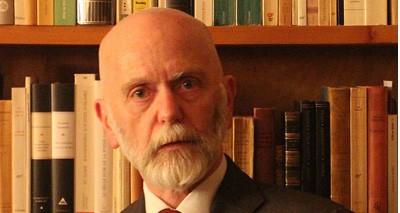

 Jean Renaud Gabriel Camus, co-founder and President of the National Council of European Resistance, is a French writer and political theorist known for having coined the syntagm “great replacement”—referring to the colonization of Western Europe by immigrants from North Africa, Black Africa, and the Middle East. He was to be a speaker at the 2020 American Renaissance conference, which was canceled because of Covid.
Grégoire Canlorbe: Your caustic, disillusioned outspokenness led you to a series of court appearances. How do you sum up the tale of your mishaps with the Prosecutor’s Office alongside the American public, accustomed to freedom of expression?
Renaud Camus: Oh, it is more than the prosecutor’s office. It is a never-ending series of appearances before a whole hierarchy of different courts, usually on charges of incitement to racial hatred. It is also under that heading that I am usually condemned. Of course, from my point of view, hate has absolutely nothing to do with it. There are none in my writings, nor any attacks on people. But hatred is the very effective name that the replacist power has chosen to give to any opposition to genocide by substitution, to any resistance to the Great Replacement, to the slightest objection to the change of people and civilization. By the way, when people start to speak of your hatred, you have to be wary: it is usually that they want to kill you, or at least to end you, to silence you.
As an example, here is the tweet that earned me the most recent lawsuits:
“A box of condoms offered in Africa it is three less drowned in the Mediterranean, a hundred thousand euros in savings for the family allowances fund, two prison cells freed and three centimeters of sea ice preserved.”
A joke, not the slightest hatred, no reference to the slightest race, and a simple reflection among others of my constant concern as for the population explosion everywhere, Europe eminently included, which makes all ecological policies pointless. Well that joke could very well get me in jail, since it will undoubtedly lead to my conviction, too, and since I was sentenced last time to a suspended prison sentence, a suspension which a new unfavorable verdict would overcome.
A young novelist, Thomas Clavel, has just published a novel, Un traître mot [A single word], which roughly accurately describes the current state of freedom of expression and repression in France today. The book is alternative history, but hardly. The imposed sentences are barely heavier than those we undergo in reality, for a wrong word one sees oneself being inflicted years of prison and re-education, but one or two years will be probably enough so that we definitely arrive, in the reality, to what is shown there. Reading A single word in Paris in 2020 it is, relatively speaking, like reading Kafka’s The Trial in Moscow in 1936. In both cases, the literary exaggeration is minimal. And in Clavel one is much more heavily condemned for words than for deeds. Power is taking out of prisons criminals by action in order to replace them in cells with criminals by opinion. We are pretty much there. As I am speaking to you, the new minister of Justice is releasing, under the pretext of coronavirus and prison overcrowding, hundreds or thousands of people convicted of theft, rape, armed assault or blood crimes. Is it in order to make room, and to fill the liberated cells with people like us, who oppose the industrial crushing of races? The Keeper of the Seals said, during his assumption of duty, that his ministry would be that of anti-racism and the fight against hate. The hatred that he slays, as we have just seen, is the opposition to the change of people. As for the anti-racism he promotes, it is the desire to mix and confuse all races, therefore to make them disappear, starting with the white-one will even say, one already says, that it has never existed, that it is a fantasy, a creation of the mind.
Grégoire Canlorbe: The late Guillaume Faye spoke very highly of you in his last published book Ethnic Apocalypse, commending your initiative to launch the NCER [National Council of European Resistance] and the speech you pronounced on this occasion in Colombey-les-Deux-Églises. He also praised your choice of words—Undifferentiated Human Matter—to qualify the way the native ordinary people is supposedly perceived by the cosmopolitan bourgeoisie. How much is your own reflection beholden to the syntagms that Faye invented—especially ethnomasochism and archeofuturism?
Renaud Camus: Oh, ethnomasochism is quite precious. I have a little more trouble with archeofuturism which is so precisely fayan, or fayesque, that it becomes difficult to handle by anyone other than its creator. But I do not despair, not admittedly to appropriate it, but to be led to make personal use of it.
Grégoire Canlorbe: You claim to disapprove all acts of violence—including those perpetrated against the perceived occupying authorities by autochthonous terrorists like Brenton Harrison Tarrant and Patrick Crusius, both of whom have made use of the syntagm “the great replacement” in their respective manifestos. What do you reply to the claim that we are presently at war with some extra-European races (alongside whom Islam serves as a rallying banner); and that in a time of war one cannot gain victory without resorting to violence against the enemy?
Renaud Camus: Brenton Harrison Tarrant used the syntagm of the great replacement without any reference to my books or to me, whose existence he probably does not even know. The appellation must have seemed relevant to him, that is all, during his stay in Europe; and seemed to accurately describe the situation he was seeing with us, all the more than it is an obvious one. The syntagm is now everywhere on the continent, it is a household name [in English in the original text]: he adopted it, good for him, although it has complicated my life a lot. As for Patrick Crusius, he refers to Tarrant and his manifesto The Great Replacement, and not in the least to me, whom he probably knows even less than Tarrant knows me. Their actions are enough to prove that they did not read me. They are as far removed as possible from in-nocence [neologism by Renaud Camus, synonymous of harmlessness], which is the central concept of my thinking. And their views are contrary to mine in almost every way. Tarrant is for example an ardent natalist, while population growth is in my opinion one of the most serious threats to the planet; and more than a threat, since it is already destroying everything there is to destroy.
[Read more…] about A conversation with Renaud Camus, for American Renaissance
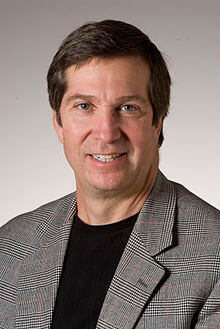
 Jon Entine is an American science writer. He is the founder and executive director of the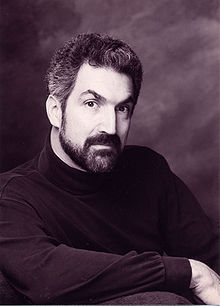
 Daniel Pipes is an American historian and president of the Middle East Forum. His writing focuses on Islamism, the Middle East, and U.S. foreign policy. His archive is at www.DanielPipes.org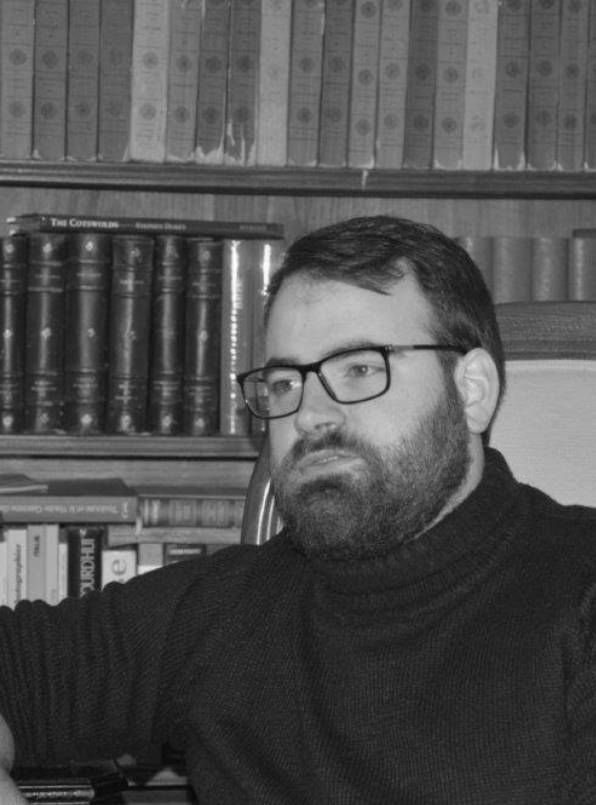
 Philippe Fabry is a lawyer and a theorist of history. His approach, which he calls “historionomy,” endeavors to identify the cyclical patterns of history. He authored Rome, from Libertarianism to Socialism, A History of the Coming Century, and The Structure of History. His website is: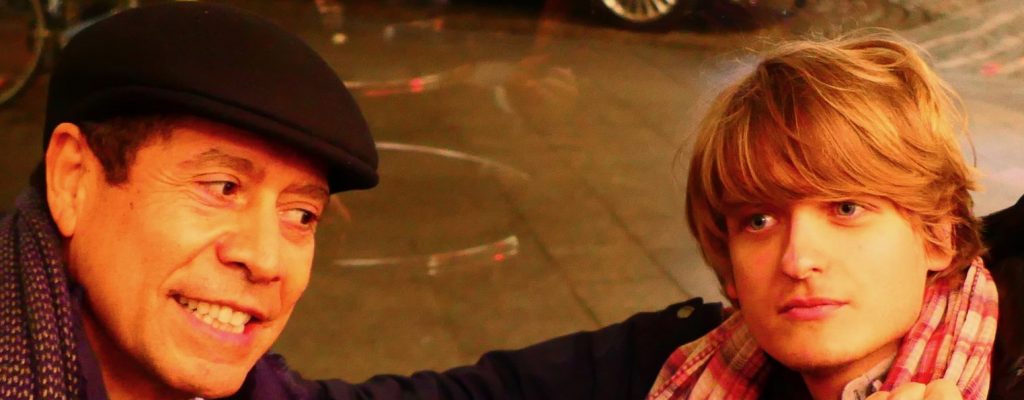
 Kamel Krifa is an actor, film producer, and Hollywood’s stars trainer—including Jean-Claude Van Damme, Michelle Rodriguez, Eddie Griffin, Steven Seagal, and many other ones. Krifa ranks among Van Damme’s longstanding collaborators and personal friends, acting alongside him in various movies. This conversation with cultural journalist Grégoire Canlorbe first happened in Paris, in July 2017; it was resumed and validated in April 2020.


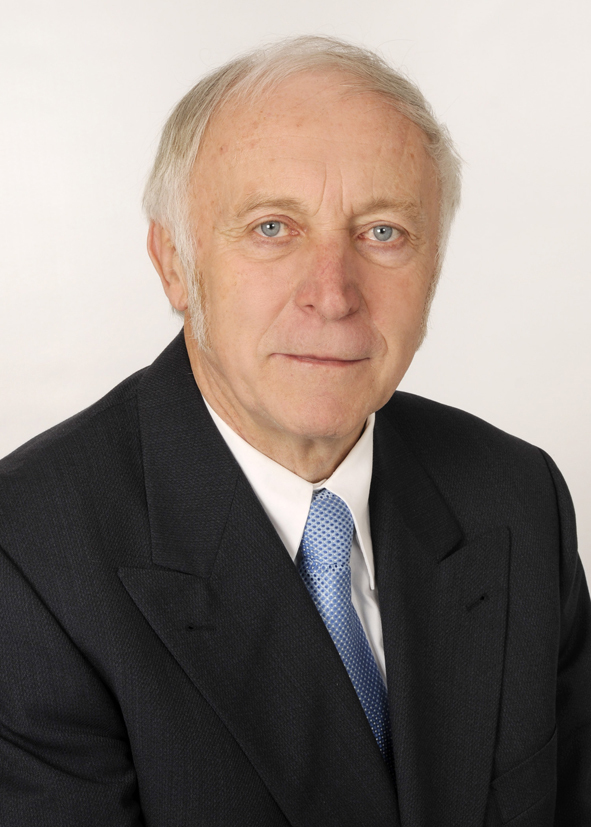
 Volkmar Weiss is a German geneticist and historian. He graduated from Humboldt University of Berlin with a doctor of science degree in 1972, after presenting his dissertation on the heredity of intellectual giftedness for mathematics and technology. In 1990 he earned his postdoctoral qualification as a geneticist with the book Psychogenetik: Humangenetik in Psychologie und Psychiatrie [Psychogenetics: Human Genetics in Psychology and Psychiatry] and in 1993 as a social historian with the book Bevölkerung und soziale Mobilität: Sachsen 1550–1880 [Population and Social Mobility: Saxony 1550–1880]. He co-founded the German Social Union in 1990 and was a member of the German Christian Democratic Union from 1990 to 1993. From 1990 to 2007, he was head of the German Central Office for Genealogy.
 Howard Bloom started in theoretical physics and microbiology at the age of ten and spent his early years in science. Then, driven by the desire to study mass human emotion through the lens of science, he went into a field he knew nothing about, popular culture. He founded the biggest PR firm in the music industry and worked with superstars like Prince, Michael Jackson, Bob Marley, Billy Joel, Queen, AC/DC, Aerosmith, Billy Idol, Joan Jett, Styx, Hall and Oates, Simon & Garfunkel, Run DMC, and Chaka Khan. Bloom went back to his formal science in 1988 and, since then, has published seven books on human and cosmic evolution, including The God Problem, Global Brain, and The Lucifer Principle. Called “next in a lineage of seminal thinkers that includes Newton, Darwin, Einstein, [and] Freud” by Britain’s Channel 4 TV, and “the next Stephen Hawking” by Gear magazine, he is the subject of BRIC TV’s documentary The Grand Unified Theory of Howard Bloom.