
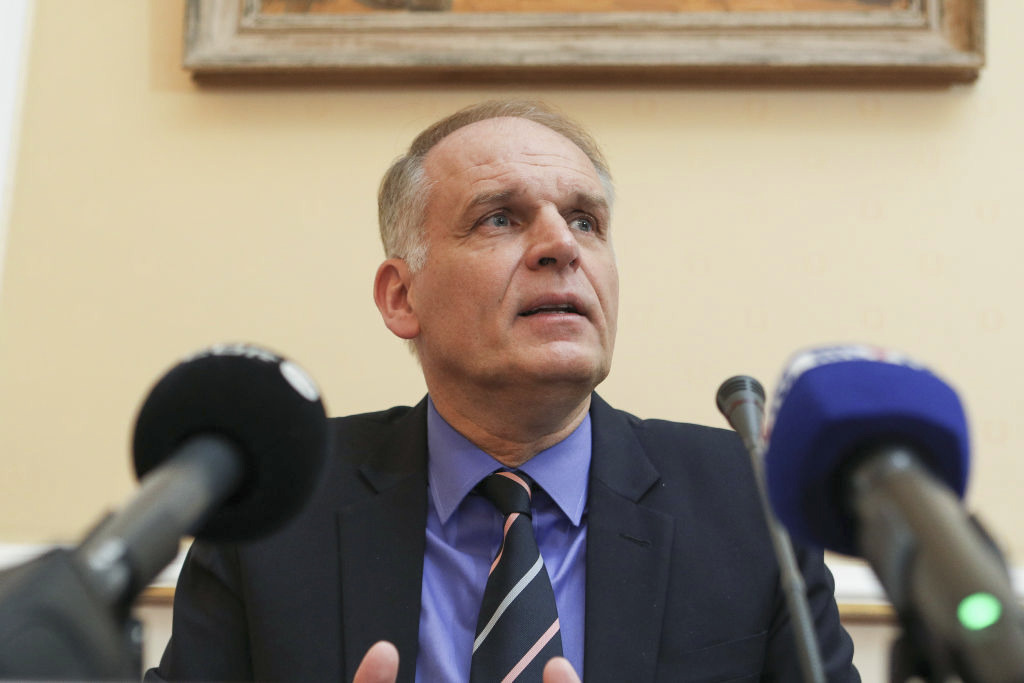
Alain Destexhe (MD), an honorary senator in Belgium, is a former secretary general of Médecins Sans Frontières (Doctors Without Borders), former president of the International Crisis Group, and former president of the Parliamentary Network on the World Bank & IMF. He has written 15 books on Belgian politics and international issues including Rwanda and Genocide in the Twentieth Century. He is a regular contributor to Gatestone, Le Figaro and several media outlets in France. He also practices medicine in France and overseas.
Canlorbe: As someone who studied the genocide in Rwanda, would you say that a genocide is also underway in Gaza?
Destexhe: A genocide targets a particular group—ethnic, racial, or religious. We can speak of genocide in Rwanda because the extermination targeted the Tutsis as a group: men, women, and children. Certainly, some Hutu opponents were also killed, but they were not targeted as members of a group.
The legal definition of genocide is probably secondary. What matters is the political definition and the historical signification: the extermination of a group. In the Middle East, the attempts at crime against humanity for more than 70 years, have been targeted at Jews. Defending oneself by responding after a major massacre is not a genocide. If you do not want your people killed, do not attack your neighbor. The October 7, 2023 massacre itself was probably intended as a genocide if Lebanon and Iran had joined in. Israel found itself attacked for the past two years on seven fronts: Gaza, Lebanon, the West Bank, Yemen, Syria, Iraq and Iran. That looks more like a genocide. In Rwanda, all Tutsis, men, women and children had to be killed; when Hutu political opponents were targeted, their wives and children were spared. They were killed by others Hutus as political opponents, not like the Tutsis for their supposed ethnicity.
As for Gaza, there is no genocide: there is no intention from Israel to exterminate the Palestinians, and women and children are not specifically targeted, even though there are, obviously, civilian casualties. What is targeted is the destruction of a terrorist group, Hamas, and its fighters. With the Tutsis in Rwanda, genocide is absolutely undeniable; in the case of Gaza, the accusation is totally unfounded.
Canlorbe: Are you concerned that the Hamas attack on October 7, 2023 is a foretaste of what awaits Europeans?
Destexhe: Yes: there exists, in a part of Islam, a fierce hostility towards the West. When Muslims become the majority in a society, it undergoes profound transformation. Other citizens—Christians, secularists, or others—then become, in a way, second-class tolerated citizens, dhimmi.
We even see this in relatively open countries such as Malaysia or Indonesia, where it is no longer so simple today not to be Muslim. These are places where Islam tends to assert itself through sharia, the Islamic legal code, even if it is not officially applied in the country.
Between Islamist fanaticism—that of Hamas, among others—and the West, Israel occupies a particular place in this region of the world. What the terrorists did to Israel on October 7, is just part of what radical Islam would seemingly like to extend to the West. They do not have the means to do so at the moment, but if they had, I am convinced they would act accordingly. In this regard, we are extremely naïve to think that this will not happen. For Europe, this prospect remains distant, but demographic upheavals could accelerate the threat.
Canlorbe: Is Islam really at fault in the hatred that Islamists express towards the West? Or does religion simply serve as a pretext to legitimate a certain slant?
Destexhe: Hard to say. I am neither an anthropologist, nor a psychologist, nor a sociologist. But yes, I believe there is what René Girard called “mimetic desire,” a wish to copy others. Overall, the populations of Belgian origin remain more affluent, as they benefit from a century of wealth accumulation: Belgian prosperity was not created overnight, it is the result of previous generations, of workers, entrepreneurs, and economic actors who enabled the prosperity of the West.
Thus, a form of jealousy or envy might arise: an immigrant who arrives without having participated in this construction benefits from social allowances but remains, on average, less wealthy than others. Yes, I believe there is a mimetic element at play here. That is why the left constantly talks about “taxing the rich”: “I want what you have, so you should give it to me.”
Canlorbe: You raised the correlation between the ethnic composition of the 2025 graduating class of the Faculty of Law at the Free University of Brussels and the decision of that graduating class to choose Rima Hassan, a French jurist and politician of Palestinian origin who has proposed a one-state solution to the Israeli-Palestinian conflict, as their sponsor. Do you see in this tribute to Hassan a sign of radicalism or capitulation?
Destexhe: The reality is more complex. In the choice of Rima Hassan as class sponsor, two factors came into play. The Arab-Muslim students—to put it simply—are now extremely numerous. There seems to be an Arab-Muslim circle comprising about 8,000 members out of around 30,000 students: that is considerable. This component appears to have played a role in the choice of the graduating class.
The radicalized European “far-left” also appears to have had an influence—it is even likely that they initiated the choice of Hassan. Overall, this choice looks as if it resulted from the conjunction of this far-left and the now very numerous Arab-Muslim students at the university.
Canlorbe: Regarding these currents of Islam which are open to interpretation and doubt, why do they prosper so little in Western universities?
Destexhe: Those seem to be minority currents that are sometimes persecuted by the dominant Islamic currents. I fundamentally believe that the crux of the problem lies in the idea of submission—Islam means “submission” to Allah and His Word, as stated in the Quran and the Hadiths. From there, the sacred text is no longer up for discussion. Whatever one may say, this text is quite harsh: the will to convert the entire world to Islam, apostasy punishable by death, Jews and Christians presented as dhimmis, “tolerated,” second-class citizens, or as people to be fined or converted. There is, in the very text of the Quran, a totalitarian aspect.
Thus, a majority of Muslims can always say: “it’s written in the Quran”—meaning said by the Almighty, like the Ten Commandments in the Bible—and consider that any other reading must therefore be erroneous. It appears to me that what poses problem is the totalizing nature of the text. Since it is not permissible in the Muslim world to contest—or even to discuss—the Quran, one always returns to the letter. Apostasy is central and regarded as punishable by death. One might reply that, in practice, the implementation differs according to Muslim people; yet, for those who refer to it literally, “it is written,” thus it is The Truth.
Canlorbe: How do you explain the hostility that most Belgian or French media have towards Israeli Prime Minister Netanyahu? It is said that Trump forced Netanyahu’s hand to reach the peace agreement and the release of the last remaining hostages still alive.
Destexhe: I must say that this discourse leaves me perplexed. To what extent could Netanyahu have been “forced”? After all, he also wanted the hostages released, subscribed to the Trump plan and had an interest in trying to conclude the war—even though it does not seem over.
With Israel, there always has to be a “bad guy”. The European left regrets the “good old days” of the Labor Party—Yitzhak Rabin, Shimon Peres, etc.—which coincided with the dominance of social democracy both in Europe and in Israel. It was this group that brought Israel the Oslo Accords, which only succeeded in legitimizing the Palestinian Authority and its ongoing “pay-for-slay” terrorism. For the past twenty to thirty years in Israel, Likud has become, almost continuously, the leading party in the country. Therefore, because Likud embodies the Israeli right, it is despised by the media and the Western “left” and designated as the scapegoat. It appears that these circles have never accepted that the Israeli majority has turned away from the “peace now” narrative put forth by Rabin and Peres, or that it has rejected the idea of a Palestinian state, although since the attacks of October 7, 2023, the idea of a Palestinian State next to Israel appears over for everyone.
In this context, Netanyahu takes on the role of the “villain”, while he is, objectively, a major statesman. He holds the record for longevity as Israeli Prime Minister, and he recently led the country in a simultaneous confrontation with several actors—Iran, Hezbollah, Syria, the Houthis from Yemen, Hamas. Even if nothing is truly over in Lebanon or with Hamas, and the Houthis retain a capacity to cause harm, Netanyahu’s track record at the helm of Israel remains positive and remarkable.
Canlorbe: What do you say in response to the discourse that assigns responsibility for October 7 to Netanyahu?
Destexhe: That is, forgive my expression, pure bullshit. What is fundamentally reproached to Netanyahu is having tolerated Qatar’s financing of Hamas—those planes filled with cash, transiting through Israel, ended up in the pockets of the movement. Netanyahu made a misjudgment—he is not the only one—in thinking that at some point Hamas would choose peace, the development of Gaza, and renounce the war against Israel. That was a mistake, period. However, this does not mean that the policy of financial injections into Gaza was intrinsically bad: it was a bet that turned out to be lost. It was a mistake because Hamas used that money to prepare and wage war. But no one really protested, certainly not even the EU, which was aware that Hamas received funds from Qatar.
I have been to Gaza twice, a long time ago. Gaza could resemble Tel Aviv. The territory is large enough, there is water, agricultural potential, and access to the sea. With peace, recognition of the State of Israel, and massive investments, Gaza could become prosperous. Saying that “Gaza could be Singapore” is not absurd; at the very least, let’s say Tel Aviv. Two million inhabitants is not insurmountable. But Hamas chose war and the misery of the Palestinian people, fully knowing that Israel would retaliate.
In Gaza, the maps of the region only show one Palestinian state: Israel was not included. In reality, Palestinians, not just Hamas, have never admitted the existence of the State of Israel. The PLO continues to claim the right of return for “refugee” Palestinians to the lands of 1948, which would mean the end of the State of Israel. By the way, after 77 years, they are no longer refugees; it is the UN that perpetuates this myth.
So I do not blame Netanyahu at all for October 7. The major failure was that of Israeli intelligence—reputed to be excellent—which saw nothing coming. The problem is having mistakenly believed, in hindsight, that Hamas could be appeased. This obviously does not make Netanyahu responsible for the attacks of October 7. That accusation is absurd.
Canlorbe: What is your assessment of how Doctors Without Borders [MSF, Médecins Sans Frontières] engages with Hamas in the context of its humanitarian interventions in Gaza?
Destexhe: I spent a total of twelve years at Doctors Without Borders (MSF) in various roles, and I am sad at what MSF has become. In Gaza, MSF is working with a totalitarian organization. Working in Gaza means working with—and under the control of—Hamas. Therefore, in my view, Doctors Without Borders has become complicit with Hamas throughout the war and should have withdrawn, stating: “We do not operate alongside a totalitarian movement and regime.” Hamas controls Gaza.
This complicity of Doctors Without Borders is inexplicable—perhaps a serious mistake that calls into question the charter of neutrality and impartiality of Doctors Without Borders. Furthermore, Doctors Without Borders’ presence did not appear essential on the ground: many Arab or Muslim organizations—Turkey, Pakistan, Indonesia, other countries in the region—could send doctors, nurses, and supplies. Muslim countries are eager to help the people of Gaza. Doctors Without Borders’s added value is zero: others could do the job. Not only has the organization found itself, willingly or not, in a situation of complicity with Hamas, but it has also endorsed the idea of a “genocide.” It has echoed, almost word for word, the campaign we led in 1994 in Rwanda—“You don’t stop a genocide with doctors”—a slogan I still saw displayed recently at Doctors Without Borders’s headquarters in Brussels.
Doctors Without Borders seems to have shifted from a neutral and independent humanitarian organization to a leftist activist organization. Gaza has not been the first signal; there were also the rescue operations in the Mediterranean, which fuel the engine of illegal immigration. Desperate people know that NGOs, including Doctors Without Borders, will pick them up at sea; despite the tragedies, the crossing remains perceived as possible, and indeed is still possible. Doctors Without Borders thus contributes to this flow towards Europe—and this is, in my view, sad and regrettable.
It is difficult, however, to take on Doctors Without Borders: it is a sacred cow in the West. A Nobel Peace Prize laureate—which I also received, as a member of Doctors Without Borders—the organization enjoys such prestige that neither the media nor even right-wing parties dare to criticize it. The role of Hamas’s accomplice that Doctors Without Borders has played in this affair has, in my opinion, not been sufficiently highlighted.
Canlorbe: Can we accuse Doctors Without Borders of covering for Hamas when it diverts humanitarian aid?
Destexhe: Yes, of course: they cover everything Hamas does. They not only condone the diversion of humanitarian aid but also the conduct of the war. All Doctors Without Borders’ posts on X regarding the conflict target Israel, I have not seen one clear call for the release of hostages. However, the release of the hostages was key to ending the conflict: the war would have stopped much earlier if Hamas had agreed to release them. Doctors Without Borders did not ask for this because the organization operates under Hamas’s control: calling for the release of hostages would have risked confronting them.
We must not forget that the Doctors Without Borders staff in Gaza is predominantly Palestinian. In a report written at the end of 2023, we showed that Doctors Without Borders members in Gaza actually celebrated the attack on October 7 and that many of them posted messages on Facebook applauding Hamas that day. Therefore, this is not just a problem of diversion of aid: it is a global complicity with what happened, and above all, an incomprehensible refusal—in my eyes—to insist on the decisive element that the release of hostages represented. They could have said: “Stop bombing civilians and release the hostages.” But no, that requirement was never emphasized. This is very serious. Unfortunately, the few criticisms—including mine—have been little publicized. Overall, if Doctors Without Borders’s image has not been tarnished by this affair, so they will not change.
Canlorbe: Do Doctors Without Borders or other similar organizations, in your opinion, care about all persecuted or allegedly persecuted populations? Or do they, so to speak, offer humanitarian aid à la carte, which would sidestep, for example, the Uyghurs?
Destexhe: The problem is that you first need access to the ground to be able to denounce a situation. The organization seems not to have access in China. Doctors Without Borders’s communication about Gaza is much more significant than about crises that are perhaps more serious but much less publicized, such as in Yemen or Sudan. “Palestine” has always held a special place for NGOs and the left.
Canlorbe: Are you sympathetic to Trump’s efforts to get Russia and Ukraine to conclude a peace agreement?
Destexhe: It is an old, wise principle in foreign policy, dear to Kissinger and Nixon, that The United States should never have as an enemy more than one nuclear power at a time. With the war in Ukraine, particularly under the Biden administration, a solid alliance has formed between Moscow and Beijing. The West, accordingly, is now in potential geopolitical confrontation with two nuclear powers. So, yes, I am sympathetic to Trump’s efforts to get a “deal” for peace in Ukraine and, from there, restore good relations between Washington and Moscow and break the alliance that has formed between Moscow and Beijing. The task, admittedly, is extremely difficult: the Russo-Chinese axis is now quite solid—although perhaps not definitive, considering a long common border, diverging demographics, and interests.
Canlorbe: According to you, the security and sovereignty of Taiwan are of utmost importance for the West. Could you elaborate on this subject?
Destexhe: The annexation of the island by mainland China would be a serious setback for the United States, destabilize the entire Pacific region, and undermine the trust of America’s allies. In reality, in 1895, after the Treaty of Shimonoseki, Taiwan became a Japanese colony. From 1895 to 1945, and then, from 1949 until today, Beijing has exercised no effective control over the island.
That the 23 million inhabitants of Taiwan are treated as pariahs in international representation—without an embassy in the classic sense, without a seat at the UN, and even deprived of normal participation in the work of the World Health Organization (WHO)—constitutes a major anomaly. Among the “new Asian tigers” (excluding Australia and New Zealand), Taiwan possesses the most advanced democracy: a free press, regular elections, and political alternation since 2000 (the first direct presidential elections took place in 1996). Taiwan actually ranks alongside European countries in democratic assessments. Supporting Taiwan and its 23 million inhabitants is therefore a geopolitical, strategic, and democratic imperative.
Taiwan is a stable state that renounced acquiring nuclear weapons in the 1970s. If Taiwan—hypothetically—had them today, Beijing’s policy would obviously be affected, and there would likely be no risk of invasion, according to the logic of “deterrence from the weak to the strong,” which General de Gaulle favored for France.
Canlorbe: How do you assess the attitude of Belgium’s current Prime Minister, Bart De Wever, on the Ukrainian issue? It seems that De Wever, ever since his term began in February 2025, has repeatedly assured Zelensky of his support while committing to Trump to dedicate 5% of Belgium’s GDP to defense spending. De Wever recently expressed, nonetheless, his opposition to the idea of using frozen Russian assets in Belgium to finance Ukraine.
Destexhe: I do not know what Bart De Wever thinks personally about the Ukrainian issue, but there is a constant: Belgium does not take positions that deviate from the European or Atlantic consensus because it derives significant economic advantages from hosting both the NATO headquarters and that of the European Union. In other words, its room for maneuver remains limited: it will always align with the consensus of the European Union and NATO, without distinguishing itself. In reality, Bart De Wever aligns with this line because he has little choice.
On the issue of frozen assets, De Wever is completely right. This seizure would be illegal. Even President Roosevelt did not seize Japanese assets in the United States during World War II. The European Union is desperate because it does not have the money to finance Ukraine, and the United States no longer wants to do so. Hence this proposal to seize Russian assets. But these are primarily held in Belgium. So it is Belgium alone that would suffer an incredible shock with the withdrawal of billions in investment from Belgium—it could be regarded as a lack of confidence in the Belgian banking system. Other European countries are much less affected and, tellingly, they do not propose to seize Russian assets in their own countries! Belgium could potentially be exposed as having to reimburse the amount of the confiscated sums, and confidence in the euro would risk being permanently shaken. That proposal is simply madness, but there is nothing surprising coming from the European Commission under Ursula von der Leyen.
Canlorbe: Brussels, which was sung about by Rimbaud and Verhaeren, now evokes less poetry. How would you summarize what has happened to the Belgian capital?
Destexhe: It is painful for the inhabitants. A few years ago, Donald Trump caused a scandal by calling Brussels a “hellhole.” In the early 2000s, Belgium—and much of Europe—adopted a series of disastrous laws that led to uncontrolled migration flows, particularly from Muslim countries. First, tens of thousands of people were admitted, creating a powerful incentive to come to Belgium. Then came an extremely permissive family reunification policy: it was possible to bring in one’s ancestors—parents and, in fact, grandparents—as well as children from a previous marriage. This welcome mat was compounded by one of the most lenient asylum policies in Europe: obtaining status of a political refugee was relatively simple, even based on false documents and hard-to-verify humanitarian arguments. Finally, access to Belgian nationality was particularly easy: three years of residence—two for refugees—with few requirements for linguistic, cultural, or economic integration. All of this has produced a spectacular demographic transformation of the country.
Regarding urban cleanliness, I also see a cultural dimension. Not all neighborhoods have the same problems. I often go to Rwanda; Kigali is cleaner than Brussels, so it is also a question of political will.
Canlorbe: Does justice play its role in the face of assaults, attacks, and shootings?
Destexhe: There is a certain “culture of excuse,” as we say in French: blaming others, avoiding responsibility, finding social roots to violence. Belgium also suffers from a lack of effective judicial tools. Unlike France, there is no immediate appearance before a judge. As a result, several months, even years, can go by between an assault and a judgment. This is a major problem because the penalty loses its effectiveness as an example. Added to this problem are prison overcrowding and insufficient prison places. In a small, densely populated country, it is difficult to build new prisons: local residents often oppose them. The result: crime is exploding in Brussels, particularly related to drug trafficking. Additionally, a situation that was once non-existent—weekly shootings—has emerged in just a few years. In Brussels, in many aspects, a general laxity has settled in. Just as there are “failed states,” Brussels is becoming a “failed city” or a “narco city”. In 2013, I wrote a small book, Brussels, A Clockwork Orange. The media mocked it. Today, statistics show that our capital is one of the three most crime-ridden cities in Europe.
Canlorbe: Regarding restoring order in Brussels, would you support a measure equivalent to Trump’s decision to send the National Guard to Washington, Los Angeles, or Portland?
Destexhe: No, I do not believe in such a miracle. The army could, of course, restore a certain calm in some neighborhoods, but the problem is deeper and structural. Fundamentally, it would not change much: the drift has gone too far, and with the current demographic composition of Brussels and its political fragmentation, it would be very difficult to turn back.
Canlorbe: Could you elaborate on the situation in Mayotte, a French island in the Indian Ocean, where you worked as a doctor and which you describe in your book Mayotte: How Immigration Destroys a Society (2025) as being at the forefront of the harms caused by uncontrolled immigration?
Destexhe: Mayotte is a French department, the department being the administrative division of France; it is the 101st, the most recent since 2011. The island has an estimated immigrant population of nearly 50%. Immigration is out of control and exploding there. The Mahoran society—French—is profoundly shaken: a climate of generalized insecurity has overtaken the place. At sunset, around 6:30 PM, the streets empty out, including in the capital, which becomes deserted—a condition that had never happened before. Public services are overwhelmed in the name of the principle of equal access: healthcare and education are offered under the same conditions to Mahorans and immigrants, leading to the saturation of health facilities and a degrading quality of services for Mahorans. Schools face the same pressure: a fourteen-year-old adolescent who arrives from Comoros or Madagascar without speaking French is placed in a class with peers his age, which lowers the overall level and places demands on the teacher to support those who are struggling. The administration is also inundated: laws—urban planning, environmental protection, turtle protection, and so on—are poorly enforced due to a lack of resources and the scale of the situation. Probably nothing can be resolved without a radical halt to migration flows. Mayotte thus experiences a harmful triptych: generalized lack of security, dislocation of cultural harmony, and exponentially deteriorating public services (healthcare, education, administration).
What I observed in Mayotte seems, to varying degrees, already at work in Belgium. When the proportion of immigrants becomes too high, the quality of education and healthcare decreases for locals. In Brussels, for example, hospitals see thousands of patients of foreign origin, most of whom have not contributed to social security. In a saturated public system, waiting times lengthen: sometimes one has to wait more than a year, to get an appointment with a specialist. This deterioration is a consequence of mass immigration that is rarely discussed. For the Belgians, the quality of public services declines. In a way, Mayotte played the role of a forerunner for what awaits us. The trend already exists, in Brussels as in certain French cities.
Canlorbe: Can we say that Wallonia—and, broadly, Belgium—are, in a way similar to Mayotte, a laboratory for leftist policies that are destroying Western Europe?
Destexhe: Absolutely. Belgium—although primarily Brussels—serves as a laboratory for what Europe might face tomorrow: drug trafficking, insecurity, a weakened state, electoral clientelism, deterioration of public services, widespread dissatisfaction, housing shortages, political impotence, … All indicators show that in Brussels the national cohesion is eroding. The myth of a “Brussels citizen” who no longer exists is perpetuated: Moroccan, Turkish, Pakistani, French, Italian, Polish communities coexist along with the people of Belgian origin, who now represent only 23% of the population. Politics has been reduced to catering to fragmented communities based on religion and on national origin (Turks, Moroccans, …) and its corollary, client-ism. During elections, Turkish candidates, for example, scour the voter lists, identify Turkish names, and target only those voters.
What do I have in common, for instance, with a Muslim woman who lives according to strict religious norms, does not work, speaks little or no French—and has never contributed to social security? This is another major issue: in hospitals, courts, and school appointments, we see people arriving with translators, due to a lack of proficiency in a national language. When looking for electoral assessors or jurors for criminal trials, many are disqualified because they do not speak either French or Dutch. Ultimately, what do we truly share with these people even if we have the same papers and political and social rights?
There was, for me, an extremely revealing moment that the Belgian media ignored. During a Belgium-Morocco match, won by Morocco, Brussels was filled that evening with Belgian-Moroccans, most of whom had dual nationality, who were celebrating Morocco’s victory loudly. That evening, it was evident to everyone that they felt more Moroccan than Belgian. Normally, having lived for a long time, or even having been born in Belgium, they should have felt both Belgian and Moroccan; clearly, that was not the case.
Canlorbe: Regarding the Turks settled in Belgium, particularly in Brussels, do they live according to the secular morals advocated by Atatürk for his people? Or do they, on average, turn towards Islamism?
Destexhe: They are increasingly turning towards Islamism because they remain much more Turkish than Belgian. It is as simple as that. Atatürk’s secularism is increasingly belonging to the past, even though much of Turkish society has tried to resist Islamization. The secular policies of Atatürk persist in part of the population, but the original identity remains a major factor of belonging: a Turk will (almost) always be more Turkish than Belgian, a Moroccan more Moroccan than Belgian.
During Turkish elections, for instance, Turks in Belgium are more likely to support Erdoğan and his Justice and Development Party [AK Party] than are voters living in Turkey, with a gap of about 10 to 20 points in favor of Erdoğan at each election. This practice also exists in France, but it is even more pronounced in Belgium—seemingly striking evidence of the primacy of original identity.
Canlorbe: Do you still hope that Belgium will recover in the long term?
Destexhe: In politics, I act like a doctor. I start by making a diagnosis: here, population change. Then I propose a treatment: here, measures such as drastically reducing family reunification and asylum. Can we still mitigate the population change even with such strong measures? In Brussels, demographic evolution is practically irreversible, especially since the Belgian middle classes continue to leave the city: this situation is only amplifying. I still have some hope for Wallonia and Flanders.
That conversation was originally published on Gatestone Institute, in November 2025