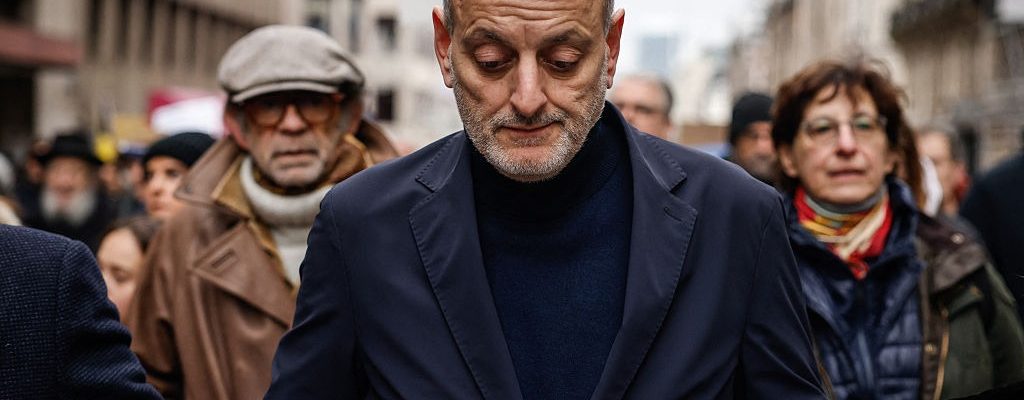

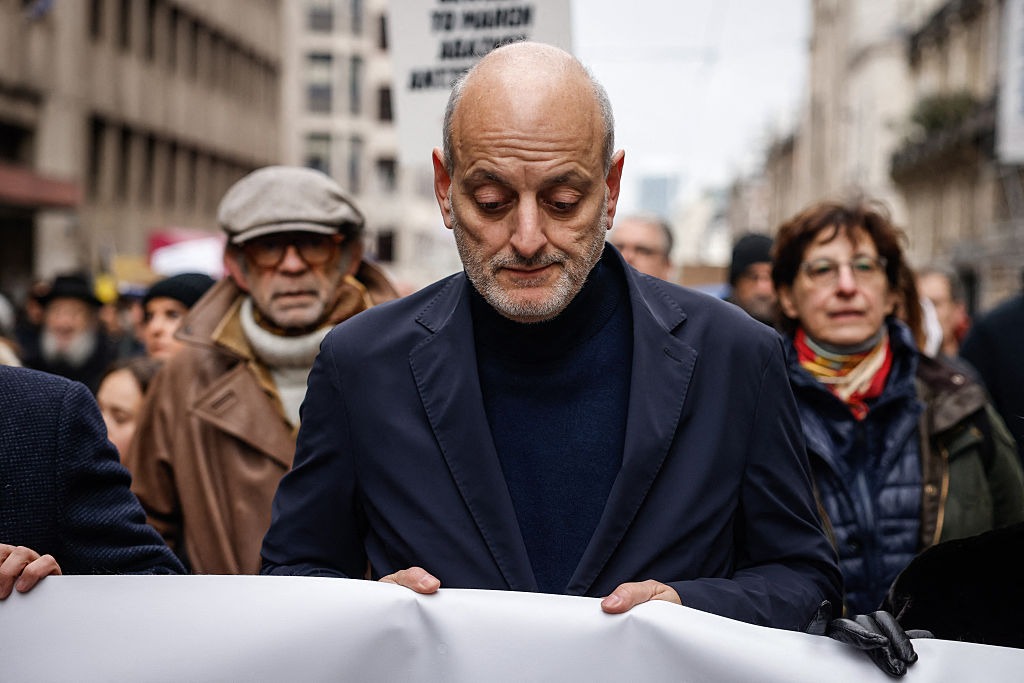
Joël Rubinfeld is a founding member and president of the Belgian League Against Antisemitism. He is also president of the Jewish Coalition for Kurdistan. He was president of the Coordinating Committee of Jewish Organizations in Belgium, vice-president of the European Jewish Congress, and co-chairman of the European Jewish Parliament.
Canlorbe: You have described Israel as the « Dreyfus of nations. » What does that mean?
Rubinfeld: Since October 7, 2023, we have been living through a kind of endless « Dreyfus trial, » but with one major difference: the state has replaced the person. In the past, Dreyfus stood on trial; today, the Jewish state has taken his place.
The « prosecutors » in this permanent trial are UN agencies, « rapporteurs, » Amnesty International, Human Rights Watch, Oxfam, the Human Rights League—which, ironically, was founded in 1901 in the wake of the Dreyfus Affair. There is also a whole ecosystem of organizations claiming to speak in the name of human rights, along with their relays in the newsrooms, in academia, in activist and cultural circles, and on the street.
When I see these so-called « pro-Palestinian » demonstrators, it seems as if many of them could not care less about the Palestinians. If they were truly pro-Palestinian, they would first call for the eradication of Hamas, which is the poison and the nightmare first of all of the Palestinian people. The poison, unfortunately, was widely embraced by Hamas’s absolute majority (56%) in the last Palestinian legislative elections in 2006.
These demonstrations in Europe—300,000 people in London, 100,000 in Brussels, and hundreds of thousands in France—remind me, of the marches in the early 1930s in Germany. Of course, it is not an exact historical equivalence, but there seems a resemblance in the occupation of public space, crowd dynamics, and the pressure exerted on political life. There are also the hateful slogans, yesterday targeting Jews; today the Jewish state and its supporters: « Death to the Jews » becomes « Death to Israel, » « Boycott the Jews » becomes « Boycott the Zionists, » the new polite, « politically correct » word for hating Jews.
This fever in the streets weighs on political leaders. The great problem is that many of them think in purely arithmetical terms. They tend to hold a simplistic, and therefore racist, view of communities: « Jews » equals « Israel, » and « Muslims » equals « Palestine. » Once they do the math, conclusions follow.
In Belgium, there are about 30,000 Jews and 900,000 Muslims—a ratio of one to thirty. Cynics conclude: « I have everything to lose by defending Jews or Israel, and everything to gain by supporting ‘Palestine’—by riding the wave of what Hamas has become in the activist imagination—because it wins me votes. »
In Brussels, given its specific demographics, antisemitism has become an electoral asset. Not the « old » antisemitism of those nostalgic for Auschwitz, but a revised, contemporary form—one that equates Gaza with Auschwitz.
For months, I have been warning that we may be living through the last time there is a « significant » Jewish community in Belgium. It is already tiny: 0.25% of the Belgian population. Possibly, by 2050 it will no longer be 30,000, but under 10,000. The exodus is already underway—and accelerating.
Canlorbe: How do you explain those Jews who join the prosecutors in this « Dreyfus trial » against Israel?
Rubinfeld: It is an intriguing question. My interpretation of « Jewish self-hatred »—a concept popularized a century ago by Theodor Lessing in Der jüdische Selbsthaß (Jewish Self-Hatred)—is that the history of the Jewish people is anything but quiet. To be a Jew has meant, for 4,000 years, being confronted with the most delirious accusations: causing famines, poisoning wells, desecrating the host, spreading epidemics, « ritual murder, » controlling the world… However deranged they may be, any accusations, it seems, can find an audience, at times even a majority one. As someone put it: « The problem is not what Jews are, but what you are ready to believe they are. »
To live as a Jew in an environment where one is blamed for everything requires resilience, self-denial, and a spirit of resistance. Not everyone is capable of that. Rather than holding firm, some might hope, out of terror and a wish to survive, that if they are just nice to their tormentor, he will soon come around and see how « good » they are. They can even convince themselves that if they agree with their tormentor, he will appreciate and admire them – then they will no longer be in danger. They might even adopt his point of view, like a child whose parent is angry with him. It is easier for him to think that the parent is right and the problem must be with himself. It is an attempt to cope with, or somehow get through, a terrifying situation — and it usually does not work. Tormentors torment; it is what they like to do. As the psychiatrist Dr. Kenneth Levin noted in his important book, The Oslo Syndrome: The Delusions of a People Under Siege, a child is dependent on his parent, and wants to feel safe. « If I just stop wetting my bed, » the child might think, « then maybe he will like me. » It is too terrifying to see that, say, the bed-wetting may not be the problem, just a pretext. We saw in World War II that people can rationalize anything.
Sometimes one finds individuals born Jewish who break with their heritage, decide to « no longer be Jewish, » and become antisemites to prove their « good faith. »
Deep down, I think they know that this break amounts to a surrender: they leave Judaism to escape the pressure, to gain social respectability, sometimes to protect their descendants. But from that point on, the Jews who remain—those who continue to embrace their identity despite the attacks—become an unbearable mirror for them.
Every Jew who stands firm reflects back to them an uncomfortable image: « I stay, I take the blows, but I remain what I am. » The one who has broken away sees himself as a coward. That tension turns into aggression: he gives way to antisemitism, adopting a scorched-earth policy. He has left Judaism—so now turns against the Jews to show everyone else. « See? I am not like them. I am good! Now do you like me? »
This pattern appears in several historical examples: Nicholas Donin (13th century), a convert from Judaism and the instigator of the trial that led to the burning of the Talmud in Paris; Pablo Christiani (Paul Christian), a converted Jew who became a Dominican and took part in religious campaigns against the Jews in the 13th century, persuading Louis IX to restore the use of the rouelle—the precursor of the yellow star; Bernard Lazare, an interesting case: he authored an antisemitic work before the Dreyfus Affair, but later became one of the earliest and most steadfast defenders of the Jewish captain, stating that the affair had « saved his life »; Gilad Atzmon, a British pro-Palestinian jazz musician born in Israel and a virulent antisemite who later claimed to have converted to Christianity—without this preventing him from continuing his attacks; Karl Kraus, an Austrian anti-Dreyfusard writer who broke with Judaism and developed an obsessive critique of what he called the « Jewish press. »
At bottom, all of this points to a simple idea: it is not easy to be Jewish. Some experience their identity as a burden. In the 19th century, even after emancipation and access to citizenship, strong social barriers remained. Many chose conversion not out of hostility, but out of a longing to get along, to be « like everyone else »—like the child, to be loved.
For me, to be clear, leaving Judaism is not reprehensible. I take a liberal view of the matter: one may enter, leave, choose—everyone does as they wish with their life. That being said, leaving Judaism is one thing; sliding into antisemitism is another. At that point, it becomes my problem: we are no longer dealing with a personal choice, but one has crossed over into active, sometimes fierce hostility directed at others—in this instance, against what one once was before.
Canlorbe: With the rise of antisemitism in Europe, what has been the result? Has there been an exodus of Jews from Belgium, and if so, what has been its scale?
Rubinfeld: Yes, there has been, although there is no precise data. We might turn to the statistics of the Jewish Agency for Israel, which records how many Jews from different countries who settle in Israel under the Law of Return, the right to come « home »—called Aliyah, to go up. These figures make it possible to tell how many Belgian Jews move to Israel each year but do not include those moving to other countries.
Many of these new arrivals are closely linked to the resurgence of antisemitism in Europe, which has unfolded in two main phases.
The first phase began in late September 2000, with the outbreak of the Second Intifada. The months that followed saw a re-emergence of unabashed antisemitism here in Belgium, mainly driven mainly by political and activist circles on the left. Since then, the spectrum has broadened.
From 2000, the numbers rose from around 60 departures a year to more than a fivefold increase over 15 years.
Before this century, departures were generally driven by ideological or identity-based choices, such as idealism or Zionism, without any sense of urgency. From 2000 onward, a different dynamic emerged: whenever a conflict broke out in the Middle East, antisemitism spiked in Belgium. This happened during the Second Intifada, which began in 2000; then during the war with Hezbollah in 2006, then on four occasions during conflicts with Hamas (2008–2009, 2012, 2014, 2021). Events taking place thousands of kilometers away had a direct impact on the daily lives of Jews in Belgium.
The second phase took place in the last two-and-a-half years, starting with Hamas’s invasion of Israel on October 7, 2023—but with a change in nature. One might have expected that the jihadist invasion of October 7, would trigger a wave of solidarity and empathy toward Israel. It did—for maybe two hours. On the very day of the attack—days before the IDF retaliated—the antisemites you see today came out of the woodwork. They exploited the war in Gaza to advance their narrative and swell their ranks—to the point of turning the debate into a form of institutional hostility.
This is also what took place in Belgium in most political parties. They began accusing Israel of committing « genocide » in Gaza, calling for economic sanctions or even a boycott of the Jewish state.
The latest example was the twelve-point anti-Israel plan pushed by Foreign Minister Maxime Prévot, a leading figure and former president of the centrist party Les Engagés, The Committed Ones. The plan includes discriminatory measures targeting not only Israel, but also Belgian Jews.
One point, particularly troubling, is a case that came to us recently: Belgian citizens in the eastern part of Jerusalem and in Judea and Samaria are denied access to Belgian consular services. A family of Belgian Jews living in Ma’aleh Adumim, in Judea, went to the Belgian consulate in Jerusalem the other day to renew their passports and were turned away. They then turned to the embassy in Tel Aviv and were refused as well. The message being sent was: « If you want a passport, move to the internationally recognized areas of Israel. »
One must grasp the symbolic meaning of this: Judea is where the name « Jew » originated. Yet today, Belgian citizens of Jewish faith are being discriminated against for living on their own ancestral land.
The Belgian authorities try to defend themselves by claiming that this is not an ethnic specification, but a geographic one. In practice, however, this measure applies only to « Belgians residing in the settlements »—that is, Jews living in the Old City of Jerusalem or in Judea and Samaria. What is ironic is that a Belgian residing in Ramallah, for example, would face no obstacle in renewing their documents. Does this also mean that a Belgian living in East Jerusalem would receive consular services—provided they were not Jewish?
I actually put this question to the Foreign Ministry spokesperson; he dodged it. He claimed not to know the answer. The question, though, is simple: what is done for Belgians living in other disputed or occupied territories—Taiwan, Northern Cyprus, Crimea, Nagorno-Karabakh, and so on? There, one does not see exceptional treatment. This is clearly a double standard, like the special « legal status » imposed on Jews during the Second World War.
Belgium has also banned the overflight of aircraft carrying materials that could be used by Israel for military purposes. That is how my country treats the only democracy in the region, which is currently fighting an existential war on seven fronts–not just to defend itself but to defend Western civilization. Belgium and other countries in Europe are trying to prevent Israel from defending itself—and Europe!
Canlorbe: How do you and other Jews view the various antisemitic acts that have occurred in Belgium since October 7? Was October 7 a catalyst?
Rubinfeld: We witnessed not just a simple increase in antisemitic acts, but an explosion.
According to figures from Unia—the inter-federal body responsible for monitoring racism and discrimination—in the three months after October 7, 2023, reported antisemitic acts rose by 1,000% — ten times higher than for the same period the previous year.
Another organization, Antisemitisme.be, recently published its figures for 2025, recording 232 antisemitic incidents—which may not seem all that many, but these figures remain far below the reality. They are just, as the saying goes, « the tip of the iceberg. »
In Brussels, for instance, there is a « pro-Palestinian » demonstration in the city center every day. It is not authorized, but it is tolerated by the city’s mayor. During these gatherings, participants openly chant the 2.0 slogan of the « Final Solution »— »From the river to the sea, Palestine will be free »—yet such incidents are not included in the statistics. If these daily occurrences alone were added, they would already exceed all official totals.
The problem is the trend. The official figures represent an 80% increase compared to 2024, which was already an abnormally high year after October 7, 2023, when levels were high.
Canlorbe: Are the French different from the Belgians in their attitude toward antisemitism?
Rubinfeld: Belgium broadly faces the same problems as France. The reactions, however, differ.
In France, when an antisemitic act takes place, it often triggers a clear public response: statements from political leaders, media coverage, and condemnations from public figures. This was seen again recently when the names of Jews were mangled by the leader of the French far left, Jean-Luc Mélenchon. The incident sparked an uproar and was denounced by many political, intellectual, and media figures.
In Belgium, this kind of mobilization is rare. Yes, there are people of integrity, but they remain the exception. In the political sphere, the most notable example is Georges-Louis Bouchez, president of the Mouvement Réformateur (« Reformist Movement, » a center-right party), who regularly speaks out against antisemitism and defends pro-Israel positions.
Of the twelve Belgian political parties, eight have embraced what is currently the central antisemitic theme: falsely accusing Israel of « genocide » in Gaza. Three of the five parties are in the governing coalition—the foreign minister himself speaks that way.
At its core, there seems to be a historic, ancient hatred that changes its vocabulary according to the era. Two thousand years ago, Jews were accused of « deicide »; today, of « genocide. » Antisemitism, like a virus, adapts to its environment. In Western societies, where religion is less important, the accusation is recast in the dominant language of the moment—that of human rights.
In addition, there seems to be a linguistic drift: Israel means Zionist means Jew. By conflation, what begins as criticism of a state gradually turns into targeting people—a « domino effect »—in France and Belgium and other places as well.
Canlorbe: Unless I am mistaken, your family on both sides, had to flee countries where there was antisemitic persecution. Morocco joined the Abraham Accords. In Russia, Federal Law No. 128-FZ of May 5, 2014 criminalizes Holocaust denial and the approval of Nazi crimes. In your view, are Morocco and Russia fallback options for Jews?
Rubinfeld: Yes, the last three generations of my father’s family had to flee antisemitic persecution, first from Russian pogroms, then from Poland, then, in 1939, from Austria, after which, they found refuge in Belgium.
On my mother’s side, the story is different. She was born in Morocco and had to leave her country in 1960 amid a growing climate of insecurity for Jews. Further back, her family descends from Jews expelled from Spain at the time of the Inquisition—under Isabella the Catholic and Torquemada—who found refuge in Morocco in 1492. Life there was not always idyllic, but my mother’s family were able to remain on the same land for nearly five centuries.
Today, as his ancestors did before him, the King of Morocco protects the Jews, but very few remain. When my mother was born in 1943, there were nearly 300,000 Jews in Morocco; today, the number is estimated at 2,000 to 3,000. Despite this, I feel a bond with the country. I do not feel a bond with Austria. I feel somewhat at home in Morocco. In fact, I feel safer walking around in Morocco than in many neighborhoods in Brussels.
I know Russian Jews living in Moscow, and they seem to live there normally. However, Russia does not really seem like a fallback option, not least because of local practices when it comes to democracy and freedom of expression.
Canlorbe: Trump is probably the most pro-Israel president America has ever had. Do you have any concerns that the MAGA movement, despite Trump’s support for Israel, could become a springboard for a new generation of right-wing antisemites?
Rubinfeld: Antisemitic tendencies can be found in every camp. On the radical fringe of the MAGA movement and the American far right, influencers such as Tucker Carlson, Candace Owens, and Nick Fuentes are injecting the antisemitic poison into the minds of millions of young people online. It is a real problem that needs to be confronted with the utmost determination.
On the Republican side, this type of discourse is relatively recent and has mainly developed around purveyors of hate active on social media. But over the past twenty years, it is above all within the Democratic camp that antisemitism has gained ground through its radical wing, such as the « Squad. »
One must fully grasp the significance of certain political signals, such as the election of Zohran Mamdani as mayor of New York. His election may herald a national trend, in two, six, or ten years. This is all the more striking given that New York is, outside Israel, the city with the world’s largest Jewish population.
Antisemitism is universal. It can be found on the left and on the right. Herbert Pagani in Plea for My Land (Plaidoyer pour ma terre) summed it up: the left-wing antisemite blames the Jews for being capitalists, while the right-wing antisemite blames them for being revolutionaries.
Canlorbe: In Belgium and France, where socialism and anti-Zionism have risen simultaneously, do you see any connection?
Rubinfeld: Antisemitism fits nicely with the views of the far left. Some authors regarded as foundational have made explicitly antisemitic statements. Karl Marx, for instance, in On the Jewish Question (1843), evidently innocent of the psychological device known as projection—attributing to others aspects of yourself of which you feel ashamed— »What is the secular basis of Judaism? Practical need, self-interest. What is the secular cult of the Jew? Huckstering. What is his secular God? Money. Very well then! In emancipating itself from huckstering and money, and thus from real and practical Judaism, our age would emancipate itself. »
This passage contains a line of thinking still present in certain minds: the idea that « the Jew » embodies money, calculation, enslavement, and that, in order to be « free », one must « emancipate oneself » from Jews. This twisted rhetoric culminated in the industrial-scale mass-extermination of Jews carried out by Nazi Germany.
Pierre-Joseph Proudhon also expresses a rather raw antisemitism: « The Jew is the enemy of the human race. This race must be sent back to Asia, or exterminated. » « Rothschild, Crémieux, Marx, Fould—malicious, bilious, envious, acrid beings (…) The Jew must disappear: by iron, by fire, or by expulsion. »
Proudhon even includes Marx, although he was not, strictly speaking, Jewish: his grandfathers were indeed rabbis, but his parents had converted to Protestantism, and Marx was baptized at the age of six. Yet beyond personal rivalries and sectarian quarrels, the central idea remains: the Jew—or the presumed Jew—is portrayed as the incarnation of evil.
The same interpretive lens is at work today among certain frameworks: whether one calls it wokism, intersectionality, or Islamo-leftism, one often finds a Marxist worldview divided between oppressors and oppressed. The designated enemy is « the white person, » and even more so « the white male »; within a Marxian or Proudhonian logic, « the Jew » ends up being portrayed as a kind of « super-white »—the ultimate enemy.
Antisemitism: it reaches levels of verbal and physical violence rarely seen in other forms of hatred, because it does not merely target an individual or a group; it constructs a totalizing myth—that of a supposedly omnipresent, corrupting force responsible for all evils.
Canlorbe: Although Bart De Wever condemned the October 7 attack, he refused to support Israel in the war in Gaza; moreover, he conditionally recognized the Palestinian state. Is that really a policy worthy of someone claiming to support Israel?
Rubinfeld: The reality is more complex.
Within the coalition, there are five parties, three of which follow an anti-Israel line: the Flemish Christian Democrats, the Flemish socialists, and the French-speaking centrists. On the other side are the government’s two heavyweight parties: the Flemish nationalists—De Wever’s party—and the French-speaking center-right party led by Georges-Louis Bouchez.
Bart De Wever is neither an outspoken critic of Israel nor an unwavering supporter; yet most likely, if left to his own judgment, he would stand on Israel’s side rather than oppose it.
The problem is that he has to hold the coalition together. The three anti-Israel parties are smaller, but each could bring down the majority by leaving the government. And for those parties, the Palestinian cause has become a central electoral issue—in a sense, a matter of political survival. So De Wever is not hostile to Israel; he is above all constrained by the internal balance of his coalition.
On the question of recognizing Palestine, Bart De Wever accepted a conditional formula: the anti-Israel parties wanted immediate recognition, as Ireland, Spain, Slovenia, and others did—and as France later put on the agenda. De Wever and Bouchez did not want to go that far.
In the end, it is a « Belgian compromise »: no one is happy, but no one is entirely losing either.
Canlorbe: What hopes do you place in conservative [in French: libéral] politician Georges-Louis Bouchez?
Rubinfeld: He represents the main political shield for Belgium’s Jews. And I do mean the man, more than the party: if he were replaced tomorrow by someone more lukewarm, it is not unthinkable that the Reformist Movement, too, could end up on the wrong side of history.
What makes the difference is his personality. Bouchez is a straight-talker, someone who is neither impressed nor intimidated. In a context where media, activist, and electoral pressure push many politicians into making concessions, this ability to stand firm makes all the difference. Georges-Louis Bouchez may not have Winston Churchill’s composure, but he does have his resolve.
Canlorbe: In your view, is Trump’s Board of Peace a viable alternative to the UN, one that could also put an end to the unfair, demonizing treatment of Israel?
Rubinfeld: When I look at the composition of the « Board of Peace, » I am skeptical.
What is paradoxical is that the founding idea of the UN is fascinating: to bring everyone to the table and try to resolve conflicts through diplomacy. In principle, it is even admirable and carried promise.
In practice, however, the UN has become something quite different. Charles de Gaulle called it « the thingamajig »; I would add: « the antisemitic thingamajig. » Today, the UN serves as the world’s leading international sounding-board for contemporary antisemitism.
Why? Because the balance of power works against the ideal.
Take the example of the General Assembly. Of its 193 member states, a majority are dictatorships or authoritarian regimes. Although the General Assembly does not « make » law in the strict sense—its resolutions are not binding—it still gives a sense of the overall climate: one of structural hostility toward the Jewish state. As Abba Eban, Israel’s foreign minister at the time, remarked in the 1970s: « If Algeria introduced a resolution declaring that the earth was flat and that Israel had flattened it, it would pass by a vote of 164 to 13 with 26 abstentions. »
To return to the Board of Peace: in principle, yes, the idea is appealing. President Trump has said that he is not trying to replace the UN — and most likely he is not, as that would completely abandon it to the dictatorships. He may be trying to make peace among countries that have a history of hostilities with both Israel and one another.
President Trump, however, may be making a fundamental mistake. He may believe that most people can be made into an ally through doing business. He does not seem to appreciate that this may not be true for countries that place religion as a priority, especially if they already have enough money through oil or are bent on global conquest, such as China
When one looks at the composition of the « Board of Peace »—with countries such as Turkey or Qatar—one thinks: this is not off to a good start. The risk is that it will reproduce the same problems as before. Now there is a boss—Trump—steering the whole thing. Fair enough. But he may not be involved forever. What happens after that?
If tomorrow the « Board of Peace » shifts to a system in which each country has equal weight, why would the whole operation not fall back into the same structural bias as the UN—the one that favors dictatorships and authoritarian regimes?
Sadly, this « Board of Peace » does not seem to solve the underlying problem we face at the UN: it risks merely shifting it elsewhere without correcting it.
Canlorbe: How do you assess American policy regarding Kurdistan, the UN and Palestinians?
Rubinfeld: Since the Lausanne Conference in 1923, nations have betrayed the Kurds again and again. The result is that the Kurdish people—the largest stateless people in the world—now number some 40 million, strangers on their own land. Yet despite being fragmented across four countries—Turkey, Syria, Iraq, and Iran—they remain one people, with a shared history, culture, and identity.
What strikes me is the contrast with the Palestinian cause, which mobilizes international opinion so feverishly. The Kurds have existed as a people since time immemorial, yet their legitimate aspiration to self-determination attracts virtually no attention and the free world remains unmoved.
The Kurds are a valiant people who have repeatedly stood by the West. This was evident in the role of the Peshmerga in the fight against the Islamic State. Whenever they were called upon, they answered. Then, every time the crisis had passed, they were abandoned again to their fate.
In that respect, Trump is doing nothing different from his predecessors: no one cares about the Kurds unless they are needed.
Take the example of the 2017 referendum in Iraqi Kurdistan: 92.7% of voters cast their ballots in favor of independence. Yet only one country publicly backed the result: Israel. In Erbil, Israeli flags could be seen in the streets—not burned but proudly waved. In the eyes of many Kurds, Israel embodies what they aspire to become: people, against all odds, who are finally masters of their own destiny.
I hope that one day the dream of a free Kurdistan will come true. If it does, it will not emerge by consensus, but probably in the wake of regional chaos.
In the meantime, since the dismantling of the Ottoman Empire, the Kurds have been paying the price of the international community’s broken promises for more than a century.
Canlorbe: Should the U.S.-Israel military operation have been carried out with a view to liberating Iran? Would such a goal be beneficial for Iran, for Israel, and more generally for the world?
Rubinfeld: For 47 years, since the Khomeinist Islamic Revolution of 1979, Iran has been the main destabilizing factor in the region—particularly in terms of support for terrorism. It is this regime that established the « Shiite crescent » to surround Israel and that the mullahs called the « Axis of Resistance »: a constellation of militias and terrorist groups used by Iran as proxies: Hezbollah in Lebanon, Bashar al-Assad’s regime in Syria, Shiite militias in Iraq, the Houthis in Yemen, and Hamas and Islamic Jihad in Gaza, Judea and Samaria. Already in 1979, Khomeini was calling for « Death to Israel, » the « Little Satan, » and « Death to America, » the « Great Satan. »
Under the Iranian presidency of Mahmoud Ahmadinejad, who called Israel a « dead fish » and a « stinking corpse » to be « wiped » off the map, the regime became known for an even more rabid antisemitism. The international conference he organized in Tehran in 2006 brought together leading Holocaust deniers, including Robert Faurisson and David Duke, a former leader of the Ku Klux Klan. At official gatherings and during Friday prayers, « Death to Israel » and « Death to America » are still routinely chanted (here, here and here). Iran’s late Supreme Leader Ali Khamenei stated that « ‘Death to America’ is not a slogan, it is a policy. »
Apart from words, there are means. Iran has been seeking to develop nuclear weapons for more than 40 years. A signatory to the Nuclear Non-Proliferation Treaty, Iran claims to be pursuing nuclear power for civilian purposes, but the level of enrichment, and the recent admission to US Special Envoy Steve Witkoff that Iran had enough enriched uranium for 11 nuclear bombs, inside of two weeks, tell a very different story. For civilian use, uranium enrichment is typically around 4%. Yet IAEA data and statements by the Iranian regime point to a current stockpile of more than 440 kilograms of uranium enriched to 60%. When the US negotiators repeatedly offered (here and here) to supply Iran with all the energy it would need for civilian use long-term and cost-free, Iran repeatedly declined. One would have to be incredibly naive to believe that Iran is not seeking to build nuclear weapons.
The joint Israeli-American military intervention was therefore necessary. It is a response to a genuine immediate existential threat—two weeks to a nuclear breakout are a clear and present danger. The Iranian population, massacred by the thousands—more than 40,000 in January alone—aspires to free itself from a regime that has ruthlessly oppressed it for nearly half a century. In Iran, it is crucial to note, the people are not the same as the regime. Senator John Fetterman (D-PA) has called Iran a « 47-year-old war crime. » Those who invoke international law to denounce the ongoing war against the regime of the mullahs are, in fact, pleading for the survival of a regime that has crushed its people for 47 years.
International law, a noble concept in itself, is today being perverted—serving as a shield for some of the worst executioners on the planet. Have the West’s useful idiots of the Islamic Republic of Iran already forgotten the tens of thousands of unarmed Iranian citizens massacred by their own horrific government in just two days, on January 8 and 9? Men such as Spain’s Prime Minister Pedro Sánchez, French politician Jean-Luc Mélenchon, and, in Belgium, Paul Magnette and Raoul Hedebouw belong to that old political tradition of moralizers whom history invariably consigns to oblivion.
There is another, deeper dimension: the relationship between the Jewish people and the Persian people, rooted in their histories.
We must go back 2,500 years — to the conquest of the Kingdom of Judah by the Babylonians and the exile that followed. Persia defeated Babylon and allowed the Jews to return to their homeland and rebuild their Temple in Jerusalem, which had been destroyed fifty years earlier during the invasion. That memory has created a historical debt.
The names chosen by Israel for its military operations, both in last June’s strikes and in the current war, the « lion » is given pride of place — »Operation Rising Lion » and « Operation Roaring Lion » – means of course the Lion of Judah, the emblem of one of the twelve tribes of Israel. The lion, however, is also a central symbol of the Persian people. It appeared on Iran’s flag before being replaced after Khomeini’s rise to power. It is precisely this historic emblem—the Lion and Sun—that is now being waved in the streets of Iran, as well as at gatherings of the Iranian diaspora—where Israeli and American flags can also be seen flying.
This sequence therefore transcends a mere military operation. It combines the urgency of the present—neutralizing the nuclear threat—with the echo of a 2,500-year-old bond.
One of the major differences with the Iraq War is that, here, there exists a credible alternative to the regime in place: Reza Pahlavi. His name is chanted in the streets of Iran. In Los Angeles, New York, London, Berlin, Paris, Brussels, and elsewhere, the same symbols recur: portraits of Reza Pahlavi and the « Lion and Sun » emblem.
Imagine the day the regime falls: Reza Pahlavi lands in Tehran on an American plane—echoing Khomeini’s arrival there, 47 years earlier, on an Air France flight. The closing shot: Donald Trump and Benjamin Netanyahu in Tehran, presiding over the reopening of the U.S. embassy and the inauguration of Israel’s.
Yet the recent developments in the US–Israel–Iran war suggest that such an outcome is becoming increasingly distant.
Canlorbe: On February 16, the American ambassador to Belgium, Bill White, raised the issue of antisemitism in Belgium and denounced the prosecutions brought against two mohels from Antwerp, accused of performing circumcisions without being doctors. In your view, was the ambassador acting within his proper role?
Rubinfeld: What he said—even if it did not conform to diplomatic standards—was fully legitimate. It may not be enough to solve the problem, but at least Bill White had the moral clarity to name it. People speak of « interference, » but sometimes the absence of interference amounts to a moral failure.
When you see Jewish graves desecrated, Jewish artists, intellectuals, athletes and businesses boycotted, incitement to violence against Jews, demonstrations where thousands chant for the destruction of the Jewish state or glorify the « martyrs » Sinwar and Nasrallah—and where leading political figures join these marches—you realize there is a serious problem in my country: a country where increasing numbers of Jews conceal their Star of David, remove mezuzahs from their doorways, hide their kippahs beneath hats, and change their names on apps such as Uber and on social media.
Let us return to the case of the circumcisers. In May 2025, Belgian police carried out raids on Jewish homes in Antwerp, targeting two rabbis who perform ritual circumcision. In Judaism, male circumcision is performed on the eighth day by a mohel, a practitioner rigorously trained in this three-thousand-year-old tradition. The reality is that circumcision performed by a mohel is the safest way to carry out the procedure—King Charles III, who was circumcised by Jacob Snowman, then the mohel to the British royal family, is a case in point.
In Belgium, to the best of my knowledge, there have never been any accidents during circumcisions performed by a mohel. The problem lies elsewhere—with the man who filed the complaint against them and branded them « butchers »: the « rabbi » Moshe Friedman.
Friedman belongs to an ultra-Orthodox Jewish sect, the Neturei Karta, known for its radical anti-Zionism. For them, the State of Israel is an « imposture » that must be wiped off the map, as the restoration of the Jewish people to the Promised Land should be the work of the Messiah, not man—whether Theodor Herzl or David Ben-Gurion.
In 2006, Friedman took part in the Holocaust denial conference organized in Tehran. At that conference, he challenged the figure of six million Jewish victims, reducing it, falsely, to « about one million. »
There are such things as Jewish antisemites – such as « rabbis » who claim that circumcisions performed by mohels have led to death or severe complications, the public tends to take such claims at face value—unaware that they are being deceived by closet antisemites.
A quick computer search turns up several cases of drowning deaths after the baptism of Christian children or adults—in the United States, Romania, Moldova, South Africa, and elsewhere. These are tragedies, but they have not called into question the practice of a two-thousand-year-old rite. No one has said: « From now on, baptisms must be performed by lifeguards, » or « this sacrament should be taken away from priests. » It is easy to see how absurd this would be.
What this dispute actually highlights is the disproportionate response of the Belgian judicial system when it comes to Jews.
On one side, on the basis of a complaint filed by an alleged antisemite, the judicial apparatus is set in motion: searches, the seizure of equipment, and a request for a list of children circumcised in recent years. One must fully grasp the repercussions of that act: the judicial authorities demand a list of Jewish children.
On the other side, when it comes to antisemitism—explicit, documented, undeniable—the response is most often inadequate or nonexistent. On October 7, 2024, exactly one year after the October 7 jihad, pro-Palestinian demonstration took place in Brussels, in the heart of the capital. From the stage, a speaker intoned in Arabic: « O Allah, burn the Jews »—and the crowd responded in unison, « Ameen. » We filed a complaint with the Brussels public prosecutor’s office, together with video evidence. To this day, there has been no response—not even an acknowledgment of receipt.
The absurd epilogue to this story is that, after denouncing these facts on Belgian and French television, I was summoned by the police after a complaint lodged by the organizer of that demonstration, who accused me of endangering him by describing the event as antisemitic.
Another time, a restaurateur put up a sign in his window reading: « Dogs welcome, Jews forbidden. » The violation of Belgian anti-racism law is pretty clear-cut. Yet the Liège public prosecutor’s office proposed mediation—which we refused—and then dropped the case two years later. In yet another case, a columnist at one of the country’s leading Flemish weeklies wrote that he « felt like plunging a knife into the throat of every Jew [he] meets in the street. » A complaint was filed, followed by an acquittal by the Ghent court. In still another case, when the leader of a political party made openly antisemitic remarks and defended Hamas, the complaint was dismissed by the Brussels public prosecutor’s office.
One can discuss complex and nuanced cases, where intention and context may be debated. But when statements are as explicit as « Jews forbidden, » « Burn the Jews, » « I feel like plunging a knife into the throat of every Jew, » or « Jews are real psychopaths, serial killers, » a judge—even a novice—should, without question, condemn such remarks as violations of Belgium’s 1981 law against racism and xenophobia.
That is where the contrast becomes unacceptable: a complaint filed by an antisemite triggers an investigation, while antisemitic acts and statements themselves go unpunished.
We are not in 1933. But there are echoes that recall the darker chapters of history: antisemitic agitation in the streets, attacks on religious practices, physical assaults on Jews, political and media incitement, boycotts of Jewish figures and businesses, the need for Jews to conceal their identity, and the failure of the justice system to protect them.
For all these reasons, I thank Ambassador White for shaking things up. This will not solve the problem of antisemitism in Belgium, but he deserves credit for bringing the issue into the spotlight.
In the Western world, over the past 25 years, only two countries have drawn millions into the streets to burn their flags and vilify them: Israel and the United States.
Ironically, that part of Western public opinion—the part that takes to the streets—echoes the very same themes as the Iranian regime: « Down with the Little Satan and the Great Satan. »
When I see people joining the pack, it seems sad that the concept of « self-hatred, » which one finds among certain Jews and Westerners, does not spare youths either—youths who may well end up in a « socialist » country that strips them of the liberties they appear to take so for granted. This Marxist and Islamist indoctrination calls into question the future of Western civilization. As the author Jaime Semprun noted, « When the eco-citizen claims to raise the most disturbing question by asking ‘What world are we going to leave to our children?’ he avoids asking the other, truly disturbing question: ‘To what children are we going to leave the world?' »
That conversation was originally published on Gatestone Institute, in three parts, in May 2026, in June 2026, and in July 2026