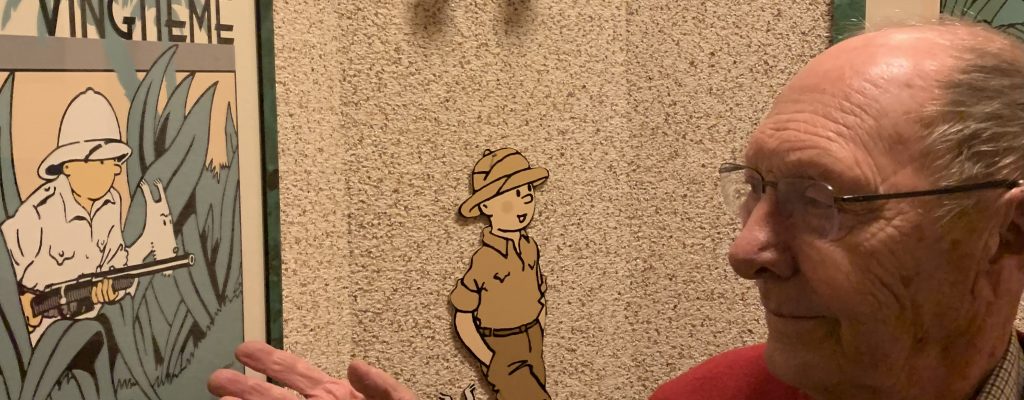

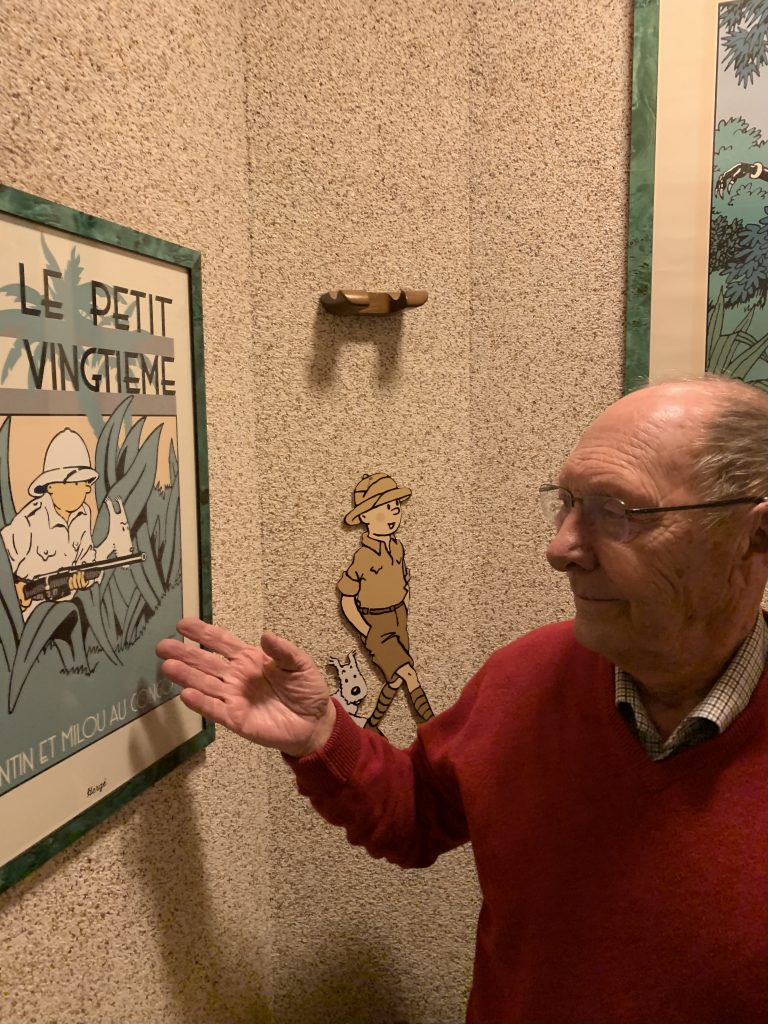
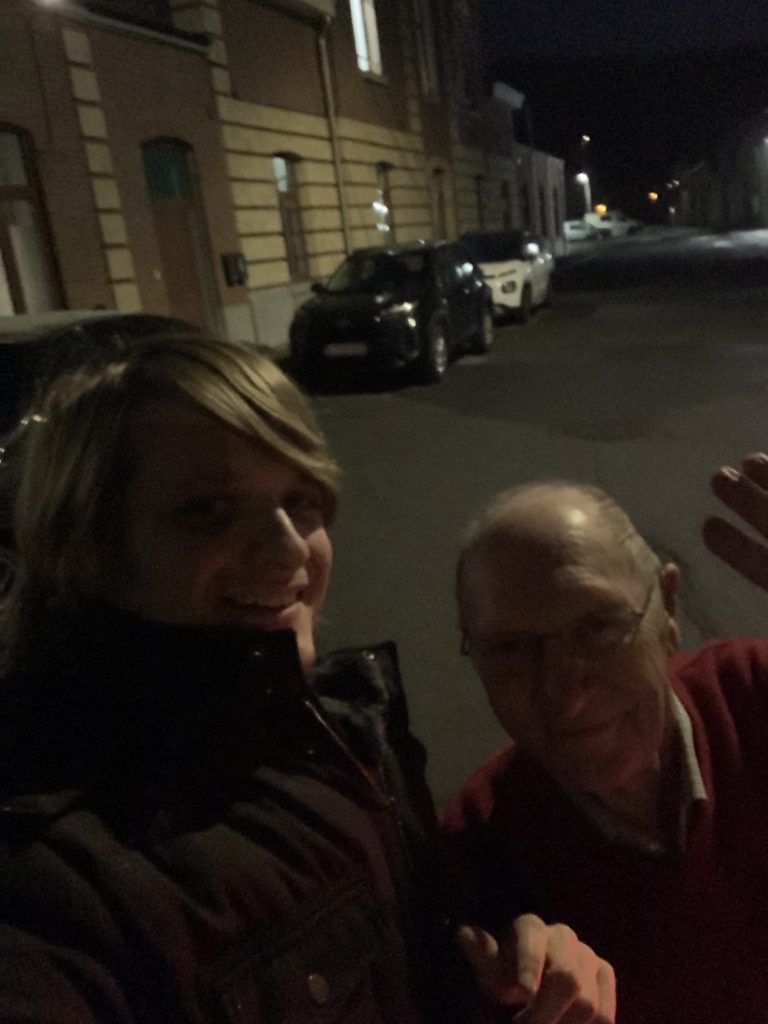
Jean-Pierre Talbot is Belgian. A teacher and then school principal, he is known for being the only real-life Tintin. Discovered as a teenager for his resemblance to Hergé’s hero and for his considerable athletic abilities, he was selected from thousands of candidates for this challenge. He acted in two live-action films: Tintin and the Golden Fleece (1961), directed by Jean-Jacques Vierne, and Tintin and the Blue Oranges (1964), directed by Philippe Condroyer. He recounted this experience in the book I Was Tintin in Film.
Grégoire Canlorbe: How does the world of Tintin differ from ours?
Jean-Pierre Talbot: That’s a tricky question. Hergé was always a witness of his time: if he were to redo Tintin in the Congo today, he would certainly start with a completely different scenario. At the time, he was criticized for the image of the “good little white man” educating the docile and kind “little black man”… and, in this logic, many gags would obviously no longer exist. Hergé would still be a witness of his time, but with a different sensitivity. He would likely highlight current realities, like the fate of child soldiers, and Tintin would seek to help them free themselves from wars in Africa.
The scene where Tintin shoots a rifle and kills all the gazelles, or the one where he blows up a rhinoceros with dynamite: today, Hergé would not draw those either.
At its core, the world of Tintin is primarily about friendship; there’s a bit of humor too. Something dynamic, but without excess: intrepid, yes, but not reckless; cautious nonetheless. That’s how I see the Tintin universe. Friendship is central and very strong, as we see with Tchang in The Blue Lotus or in Tintin in Tibet.
Grégoire Canlorbe: How do you react to the message—in favor of GMOs—of the second film?
Jean-Pierre Talbot: I experienced the filming as an adventure happening to me, without ever philosophizing about it.
Regarding GMOs: first, it’s not really a script by Hergé, it’s a script by André Barret, who is also a co-producer. The story is by Goscinny, Philippe Condroyer, Rémo Forlani, and Barret, based on Hergé’s work.
The hunger in the world was indeed set against the backdrop of the plot, but the idea was mainly to fuel the adventure. A colleague of Calculus [in French: Tournesol] presents an invention: inedible oranges, but capable of growing in the desert. Essentially, it’s not so much a story about GMOs as it is a story of scientists seeking a solution to combat hunger and, in a way, “save the world.”
Grégoire Canlorbe: You filmed in Turkey and Greece for the first film; then, for the second film, in Spain.
Jean-Pierre Talbot: The old quarters of Istanbul are wonderful. At times, I felt a bit like I was in the Middle Ages—in a good way. We didn’t have much contact with the locals: the residents were mostly there, watching us shoot. Tintin—Tenten—is, by the way, very popular in Turkey.
I also have a memorable experience of Greece. I love sports, already… and as someone who did athletics, I felt like I was “taking the start” in stone starting blocks at the Olympic stadium.
In Spain, however, the atmosphere was entirely different. When I filmed there, it was the Civil Guard, and I was constantly reminded: “Don’t put a foot out of line. The Civil Guard, you do what they say, right away.” It was the time of Franco.
Grégoire Canlorbe: You played alongside two successive actors for Haddock, as well as for Calculus. What comparison do you make?
Jean-Pierre Talbot: Yes, almost all the actors were different from one production to the next. Between the two films, there were hardly anyone left except for Milou and me.
For Haddock, there was, first, Georges Wilson. He was lively, with a huge presence: he could almost have pushed himself in front of the camera, taken all the space, and made Tintin a secondary character. He had a wonderful presence; he was a marvelous actor… but he was really showy. I was sixteen at the time, and after two days of shooting, I told him, “Hey, Georges… the star is Tintin!” He said, “Huh? What?” And the producer told him, “Yes, Georges, keep it up…” Then he added, “Jean-Pierre is right.” It wasn’t to elevate me: it was to prevent him from “eating” the character of Tintin. In the end, it went very well.
Besides, I didn’t like to rehearse. He, on the contrary, needed to rehearse, rehearse, rehearse. He had directed the national theater at the Palais de Chaillot, succeeded Jean Vilar at the Théâtre national populaire… so, naturally, rehearsal was part of his method: the more he rehearsed, the better he was. Whereas for me, the more I rehearsed, the more it became linear, flat. It was really in the first take that I was just right.
Then, there was Jean Bouise. With him, it was much more intimate: more philosophical, more humorous, simpler, perhaps. He might have lacked a bit of presence and liveliness, but I believe the combination of the two would have produced an exceptional Haddock. That said, both of them played their roles very well. We got along well; we worked well together.
In the first film, The Golden Fleece, Professor Calculus was very endearing: he was a true “clown,” the oldest clown in France. Georges Loriot, very lively, a magnificent character. And there were also Charles Vanel, Marcel Bozzuffi, Darío Moreno… In short, quite a dazzling cast. In The Blue Oranges, Félix Fernández was just as extraordinary in his portrayal of Calculus.
The Golden Fleece and The Blue Oranges were heavily criticized by so-called « intellectual » critics and Parisian hipsters: “It’s bad, everyone is bad,” and so on. While the public responded enthusiastically.
Grégoire Canlorbe: You acted for two distinct directors: what do you take away from their respective methods?
Jean-Pierre Talbot: We shot while being witnesses to what was happening, as if it were live, real. And yet, it was still cinema: a lot of waiting. Waiting for everything to settle, waiting for things to come together, waiting for it to happen.
If one of the two directors had techniques that the other didn’t, I didn’t really notice. I wasn’t a technician. What I can say is that both films were shot in the same way.
What is quite surprising is that at the end of both shoots, I would have been incapable of recounting the story from beginning to end. However, I could recount each sequence, each scene, each passage in detail. Simply because we don’t shoot in order: we shoot by locations. We arrive at a place and film what’s happening there, whether it’s the end of the film, the beginning, or the middle. We don’t follow the chronology.
And everything was outdoors, which was very pleasant. The interiors were done in the studio—but very little. Fifteen days, three weeks maximum. I remember fifteen days in Boulogne-Billancourt.
Grégoire Canlorbe: A third film, it seems to me, almost happened, and it was supposed to be set in India.
Jean-Pierre Talbot: I heard that the third film was supposed to take place in India, with horses, etc., but I don’t really remember it. In fact, I never read the script.
This third film didn’t happen for several reasons. First, the producer had made a very good living: we had almost as many admissions as La Grande Vadrouille. It was the era of neighborhood cinemas, with endless lines on the sidewalks for each screening, every two hours. It was very impressive. In short, he had made his business.
Since he wasn’t a full-time producer, he also had another life. Thanks to the films, he was able to acquire a nice little château on the Loire—not Cheverny, but a sober, very decent château. At one point, he simply said, “Okay, that’s enough.”
On my side, after the first film, I completed my studies and then I started teaching. I then shot the second film. I set a very clear framework: “I am free from the beginning of the Easter holidays until the end of the summer holidays. If the film is ready, that’s six months: we can make it.” If I had these requirements, it was because I was a teacher. Parents entrusted me with their children; they didn’t want to see me clowning in front of a camera afterward. This created difficulties for the making of the third film. Television came to the classroom, journalists came too, and the children were often on screen. They had their photos in many newspapers. In their own way, my students had become stars.
Grégoire Canlorbe: Did you take part in the writing of “your” two Tintin movies?
Jean-Pierre Talbot: Not at all. On the other hand, I knew Tintin much better than the producer who wrote the script. How many times did I not say, “But Tintin would never do that!” I was answered, “Yes, but it’s in the movie.” Okay… then we discussed it with the director and the producer: “What would Tintin do then?” “Well, simply this.” And every time, my opinion held authority.
Moreover, in the second film, it was I who suggested abandoning the blue sweater for the yellow polo, because it fit Tintin better. I also added little details that I had noticed in the albums. For example, at the moment when we think we’ve found the gold from The Golden Fleece, I improvised a little Russian dance: in the albums, when Tintin is happy, he often does this kind of little dance. These are details, but they matter.
And above all, I brought a lot of atmosphere, a lot of momentum: “Come on, let’s go!” I added rhythm, pushed the energy, and tried to give movement to the whole.
Grégoire Canlorbe: As a teacher who has written your memoirs, what difference do you see between the art of writing a narrative (whether autobiographical), the art of writing a comic book, and the art of writing a film?
Jean-Pierre Talbot: I am not an intellectual—not to that extent. For me, whether one is working on a narrative, a comic, or a screenplay, there has to be a framework first. Then, this framework gets dressed up, builds itself, as long as you have a clear line, a line that carries the story.
I wouldn’t really know how to explain it better, but comic books are a bit like cinema—except that you have time to build it. You can modify, adjust, go back, refine. But without a solid base—a good story foundation, a good script—I don’t see how one could make an excellent film.
Grégoire Canlorbe: How do you explain the explosion of creativity that occurred in Belgian comic books from the 1930s to the 1980s?
Jean-Pierre Talbot: Belgium, at the time, was a real hub: they saw each other, laughed together, supported each other, engaged, and drew everywhere. There was a very strong sense of camaraderie. You could find that spirit in France as well.
For example, François Walthéry—the artist of Natacha, still very well known today, and a good buddy—worked for Peyo, he also worked for Franquin. At that time, they all worked for each other. That’s what made the scene thrive.
Grégoire Canlorbe: As a teacher and school principal, have you noticed a decline in standards?
Jean-Pierre Talbot: I have indeed noticed a decline in standards, but not during the time I was teaching: I have been retired for a long time. I stopped at 58, and I am 82 today… I am an old man, on the edge of the abyss.
If we talk about spelling or grammar—which includes our direct object—I can tell you that when I had a sixth-grade class, the last year of primary school, the children wrote. They really wrote. Today, they have pre-made sheets, they do nothing: everything is told to them.
Grégoire Canlorbe: Did Tintin character have a particular importance for you before you became him onscreen?
Jean-Pierre Talbot: Of course. I should say that I was born in 1943: I learned to read around 1949, in the early 50s. On Saint Nicholas Day, all the little Belgians received a Tintin album, a Dinky Toys car, a marzipan pig, two or three Nik Naks, and a tangerine. That was the ritual.
So naturally, I knew Tintin very well. We had newspapers, we didn’t read much else, and television didn’t exist. Thanks to the albums, I discovered that there were animals in Africa, skyscrapers in New York, Inca civilization, China… In short, we discovered the world through Tintin.
And then there were beautiful adventures. There was a real bond of friendship, a certain rigor, politeness, decorum. There was also a lot of humor—sometimes with a little excess, especially because of Captain Haddock and his only “small defects.”
Deep down, I was truly immersed in the world of Tintin, without being an obsessive fan. Tintin was simply part of my life, as it was for many. That’s why older generations remain so attached to it, even today: they grew up with Tintin.
Grégoire Canlorbe: How did you so easily get into the character’s shoes?
Jean-Pierre Talbot: I never “got into the skin” of Tintin. I acted as if the adventure was happening to me, and ultimately, it matched up. Besides, before all this, no one had ever told me I looked like Tintin: neither my friends, nor my family, no one.
And then, it’s important to understand one thing: Tintin’s face, in reality, does not exist. It’s an oval, an ear drawn like a cup handle, two black circles for eyes, a little bit of a nose, a mouth reduced to a dot or a line… no eyebrows. So, in the end, no one really looks like Tintin.
It all started on the beach in Ostend. Someone approached me and asked: “Do you know Tintin?” Of course I knew Tintin: everyone knew him. I replied: “Yes… are we making a film? What a great idea!” I thought they were going to ask if I had someone among my friends who could fit the role. But no: they asked if I would accept.
I had no idea what it represented… except that, in my heart, I was already there. A photo was sent to Paris to the producer. I was then called for a first audition. Apparently, they had been searching for three years, through the press, etc. Many well-known actors had come forward, and even—apparently—a little Japanese boy who said: “Me, I am Tintin!” I never felt like Tintin. Yet, they took me on this adventure.
It was during the school holidays, around August. I was a sports instructor on a beach in Ostend because I was aiming for teaching and I did a lot of sports. My two “areas” were kids and physical activity: helping the little ones not to be afraid of the water and to dare to put their heads underwater, organizing races, games, high jumps, long jumps… sports, basically.
Ten days after school started, I was called to Paris to do a screen test. They put me in pants: “But come on, this is not Tintin’s pants! Look how thick it is! And the color… it’s too brown!” I knew Tintin better than they did. They stuck a “Mohawk” tuft on me: it’s true that it sometimes goes like that, but everyone knows it’s mainly parallel to the forehead… And then they took me to a set where they were filming La Princesse de Clèves with Marina Vlady and Jean Marais.
I was sure they wouldn’t choose me. I was just discovering a film studio: it was already a wonderful experience. I never saw Jean Marais or Marina Vlady: there was a well of light, technicians around, twenty or thirty people. I was behind all that, and suddenly I hear: “Cut!” Then: “Oh no, no, no, the camera is rolling! Come on Jean-Pierre, move forward. The camera is rolling, do what you want!” So I thought: Tintin is someone nice, sporty… I’m going to be nice and I’m going to do sports. It was smarter for me than reciting a fable from La Fontaine that I didn’t master, and anyway, I didn’t want to “give myself up” as an actor. I was opening up where I felt best.
And I made everyone laugh. I started with acrobatic sequences—what we called a “cumulet,” forward-backward—then a front somersault, a back somersault. I had no space, no momentum, so I attempted a flip. No risky moves: I would have needed momentum and someone to protect me. Everyone was laughing. And to finish, I did an asymmetrical bump: you act like a puppet, arms and legs in the same direction, then suddenly the legs continue on one side and the arms go off the other. We did that several times, there was even a technician who tried… I created a lively atmosphere, that’s it. What do you want me to do else? They put me back on the train: “Thank you Jean-Pierre, that was very good.”
A week later, they called me again. This time, they said: “Jean-Pierre, it’s going to be more difficult, you will really have to act.” Okay. They dressed me up as Tintin. They had changed the pants: the fabric was no longer thick, on the contrary, it was too thin, it looked like a veil, something that floats… in short, ridiculous. I put on the one I preferred and they took me to the surroundings of Paris, to a small villa with a garden. And there, I spotted two or three boys, further away, dressed as Tintin. And I also saw someone dressed as Captain Haddock.
Later, I understood: the ‘Haddock’ was Georges Wilson. He had already signed on. And I suppose the producer had told him: “Take a look, Georges, see if we can do something with that kid there.” They made me do a simple scene: Snowy [in French: Milou] under my arm, bandits behind me, hiding behind a tree and observing. It wasn’t difficult, but I found it amusing.
Then, I was chosen. From then on, I stayed in Paris for four or five months. They wanted me to do a whole bunch of things, including acting classes. I didn’t want to: first because I was lazy, and mainly because I didn’t want to learn lines that didn’t interest me. On the other hand, I was observing. I watched how it all happened. I picked up details, looks, I understood things. I also went to see rehearsals at the Théâtre national, at the Palais de Chaillot, and I learned a lot—not by doing, but by watching.
They also wanted to “create” Tintin: how he walks, how he treads the ground, how he moves his heel, his arm… They told me: “Be Tintin.” But if I walked like that, it didn’t work. I had to take mime classes: I became a puppet, it was ridiculous.
Then, I was taught judo. There, however, I was truly in my element. Two years later, I had a black belt, pre-selected for the Belgian national team, among the top five Belgians. I was very sporty: at fifteen, I was a finalist in the Belgian 100-meter championship, running in 11”5–11”6. And at that time, there wasn’t any track surface: it was cinder, sometimes wet… anyway, it didn’t matter. I felt good when moving.
Grégoire Canlorbe: What role did Hergé play in your training?
Jean-Pierre Talbot: What really boosted me was the first time I met Hergé.
I had an appointment that ended earlier. Like a good little boy, I returned to the production to ask what I needed to do. And on that day, Hergé was in Paris. He hadn’t announced himself: he was there for a reason that concerned no one. No matter. He thought: “Well, I have a bit of time, I’ll drop by to say hello to the production.” As a result, we arrived at the same time. To production: “Hergé, Jean-Pierre is here.” And to me: “Jean-Pierre, Hergé is here.”
I wondered what he would say. In reality, I hardly cared: whether they found me a good or bad actor, that wasn’t the main thing. They had been looking for three years, I was doing them a favor, and I was just having fun making a film, that was it. But I still had a mission. I knew Tintin, I had grown up with him, and I really didn’t want to disappoint the children. So what Hergé would think when he saw me… I was inevitably a bit apprehensive.
I suppose he had already seen the photo. And then he said it himself: “It’s not my film.” But if it strayed too far, he could also say: “No, this is ridiculous: this is no longer Tintin, we need to change the title.” Basically: it’s not his film, okay, but if we keep the name Tintin, we need to stay within the framework.
Barret had warned me: “You will either be boosted or completely annihilated.” Barret introduced me: “Jean-Pierre, Hergé.” And there… there was a silence. It seemed to last an eternity, when in fact it was only a few fractions of a second. Hergé placed his hand on my shoulder—I remember it as if it were yesterday—tilted his head, very paternal, and said to the producer, with a smile… He didn’t say: “You made a good choice,” nor “He looks like him, he’ll do.” He simply said: “It’s him.”
And that, really, boosted me. The next day, since Hergé was still there, I was dressed for the first time as Tintin “in full”. They took me to rue Mouffetard in Paris. Paris Match was there. Hergé was there. And I walked, wondering what was going to happen. And then, suddenly: “Tintin! Tintin!” Five, ten, fifteen, twenty… thirty, fifty… a hundred people around me, little by little. And they asked me for autographs. It was very strange, almost embarrassing. I signed: “Sincerely, Jean-Pierre Talbot.” And then no: I was no longer Jean-Pierre Talbot. People wanted Tintin. Tintin.
So I looked at Hergé, a bit lost. And he made me understand: “But yes, Jean-Pierre, you must.” He recognized me as Tintin. He allowed me—and even invited me—to sign as Tintin. And since then, I sign as Tintin because the public wishes it. But I always add my name, Jean-Pierre Talbot: not to make myself known, simply out of respect for Hergé.
And what is incredible is that I still receive mail today. Not from twenty-year-olds, of course, but from those who are fifty, sixty… For them, the first time they see me, they get goosebumps, tears in their eyes. They don’t know how to address me: “Mr. Tintin… Jean-Pierre…” And they say to me: ‘You made me dream.’ That really means something.
Grégoire Canlorbe: Do you have a particular interest in Bécassine character, which inspired Tintin?
Jean-Pierre Talbot: No, I have never had a particular interest in the character of Bécassine. I simply know that Joseph Pinchon drew the original albums, and that Béja draws the new Bécassine.
I have been involved for a long time in organizing sporting events. I went from tennis to skiing, and then I dedicated myself to canicross. I am practically the founder of canicross in Belgium: I was the president of the Belgian federation, I created the International Federation, and I am still a member of the board of directors. I also launched a race that is now in its 25th edition—next year, it will therefore be the 26th. This makes it the oldest canicross in the world in a relatively recent discipline: some events may have existed earlier, but none have lasted as long.
For the 25th edition, everyone knows who I am—Tintin—and we thought we would emphasize Tintin a bit to mark this anniversary. So I set up an exhibition with old canicross-related objects—old bibs, posters, photos—but also pieces related to Tintin: my golf pants, the blue orange, the helm from the Golden Fleece, drawings—notably by Hergé—and other souvenirs.
For the occasion, we even replaced the traditional medals given to winners on the podiums with a drawing. And this year, a drawing of Bécassine will be offered.
Grégoire Canlorbe: Would you say that the character of Tintin changes throughout the albums, becoming, for example, a bit more relaxed (like when he does yoga in Tintin and the Picaros)?
Jean-Pierre Talbot: I don’t find that he changes much, no. He is—and remains—very active. At the time, he did yoga to relax; today, he would probably go jogging. By the way, in The Golden Fleece, I’m the one who said Tintin should go jogging in the morning, with Snowy, in the garden of Moulinsart.
Grégoire Canlorbe: Over the course of the two films, do you think the character evolves?
Jean-Pierre Talbot: No, the character remains the same. Apart from the golf pants and the trait, the character hasn’t changed either in the drawn stories. At the very beginning of the character, there is a more abstract drawing, in the style of Art Nouveau: he doesn’t really have the look of Tintin, he has, for example, a coat that is askew.
Grégoire Canlorbe: Would you agree to play an aged version of Tintin?
Jean-Pierre Talbot: Tintin does not age. I knew that a third film was possible. But I had made a clear condition: my priority was to shoot between the beginning of the Easter holidays and the end of the summer holidays. If it wasn’t feasible in that time slot, then it wouldn’t happen.
And then, I found myself at thirty. At that point, I said to myself: if they offer me the film now, I will say no. I won’t run as fast anymore, I won’t be as lively, I will be older… I won’t be Tintin anymore. That’s all.
I actually talked about it with Hergé. I asked him: “But how old is Tintin?” I already knew what he was going to say. He told me: “For me, he is between sixteen and eighteen years old.” “But come on, that’s not possible: he no longer lives with his parents, he has a driving license, an apartment, he ‘works’…” “Yes, I know, but for me, Tintin remains in that age range.”
Grégoire Canlorbe: What would you think of a film adaptation of Tintin and the Alph-Art, which would propose an ending to the story left unfinished by Hergé?
Jean-Pierre Talbot: I agree that there should be no other drawn stories of Tintin. A film adaptation of Tintin and the Alph-Art that invents an ending, why not.
There are, however, talented artists capable of pastiching Tintin and imagining a coherent conclusion to this story. I know one, a Canadian, who created a pastiche of Tintin and the Alph-Art proposing an ending—Yves Rodier. He does not have permission to sell this album. There is also a French, Harry Edwood, whose style is very close to Hergé’s.
Grégoire Canlorbe: How do you see the evolution of filmmaking between your Tintin movies and Spielberg’s?
Jean-Pierre Talbot: Before, it was a studio camera: long like this, wide like this, tall like this, and soundproofed. We shot on film, and it was expensive. Today, you can almost shoot with a camera.
For Spielberg, there are parts that I loved… and others that horrified me. Overall, I like the script: the mix of three stories is felt, and it complements quite well, I think. There are very nice visual discoveries: for example, the dunes by the sea, those dunes that become waves, and those in the desert that also transform into waves—it’s really beautiful.
The battle of the ancestors on the Unicorn is superb. The idea of the descendants then fighting with cranes is very clever… but the fight lasts half an hour: after a while, you get bored. Cranes doing this, then doing that, and doing that again… it’s padding, it’s ridiculous.
On the other hand, the scene with the sidecar chasing the parchment carried by the bird is magnificent: that’s really Tintin. But once again, it lasts too long. He should have shortened it, saved some time. And with that time, he had plenty to add Calculus’s submarine.
There is one thing that horrifies me: Hergé would never have let that pass. He would have forbidden it. In the scene with the yellow plane in Africa, out of fuel, Haddock makes a reference—supposedly a whiff of alcohol—to restart a dry engine… But it’s vulgar! How could such a passage be allowed? That’s not Tintin. Period.
So yes, the film remains close in places, and there are really very beautiful, even genius parts. But who am I, a little schoolteacher, to dare criticize the great Spielberg?
Grégoire Canlorbe: What do you think of Jamie Bell’s performance?
Jean-Pierre Talbot: He moves wonderfully. I admired him in the film Billy Elliot. By the way, they all acted (moved) very well.
Grégoire Canlorbe: You performed the stunts for the role of Tintin yourself.
Jean-Pierre Talbot: I did everything except pilot the helicopter. I shot in the studio for the scenes where I pretended to pilot, but it was interspersed with shots of a real pilot.
Grégoire Canlorbe: The tower scene is iconic for the character of Tintin, and for your stunts.
Jean-Pierre Talbot: The descent from the tower: that day, I had a blast.
I arrive on site: the tower was about twenty meters tall—maybe 20, 25, even 30—and it was also placed on a small hill, which further accentuated the feeling of height. I was really happy because this kind of scene pleased me. In contrast, when I had a day with lines to say, I didn’t enjoy it at all.
And then I see two guys dressed as Tintin. I wonder, “What are they doing here?” I’m told: “Well, Jean-Pierre, you see… it’s too dangerous, the insurance prohibits it. You’re not going to do it.” So I protest: “No, no, no! Going down is easy. Climbing might be harder, but going down, there’s no difficulty. And it’s my scene!”
Especially since I was equipped: under my sweater, I had a fireman’s belt, with a rope and carabineers. There wasn’t a net, true, but if I got into trouble, I could clip myself. Well… if I clipped myself, someone would obviously have to come and get me.
Honestly, the descent is quite easy. Even today, I think I could do it again. So I insist, and they let me do it. And it’s true that the only moment I had a shock was when I straddled; I thought, “Oh my, I can’t believe it.” But once I launched, there was nothing left to do but go for it.
I was there, both hands almost in the void. But really, everyone is capable of holding onto a bar: whether there’s a void below or just fifty centimeters, the gesture is the same.
We did it in one take, with three cameras. Finished.
Grégoire Canlorbe: The scene of the dive and of the chest’s retrieval is equally iconic.
Jean-Pierre Talbot: A good half-hour in the pool, to empty the mask! However, it wasn’t deep—no more than seven meters.
Grégoire Canlorbe: Let’s also mention the scene with the rope in the well, the chase scene in the market, or the various fight scenes.
Jean-Pierre Talbot: Climbing the rope in the well was just as enjoyable an experience as descending along the tower.
The market scene was great: we had a lot of fun. There was a carriage, Haddock was getting agitated… I didn’t have a ton of things to do, but it was really very fun.
As for the fight scenes, I prepared them with my judo instructor, and they were equally fun.
Grégoire Canlorbe: Of the two castles used as a backdrop for the scenes set in Moulinsart, namely Villette for The Golden Fleece and Écully for The Blue Oranges, which do you find most akin to Moulinsart?
Jean-Pierre Talbot: I find that Écully has no relation to Moulinsart, at least for the outside. That said, you don’t see much of it from the outside anyway. The interior? We filmed indoors, there you go. Whether it’s there or elsewhere, in the end, it’s the same.
In contrast, Villette resembles Moulinsart much more, if only because of the park and the surroundings: the color, the volume, the general appearance. But over there, we didn’t film inside. We had nothing to do there: everything happened outside.
Grégoire Canlorbe: The Château de Cheverny, the inspiration for Moulinsart, hosts a permanent exhibition about Tintin.
Jean-Pierre Talbot: I’m going to do a signing at Cheverny in June. The permanent exhibition is a bit small; I would like the Marine room to be much more extensive. I haven’t seen the exhibition in a few years, but I will see it again, then.
So we say: see you at the Tintinophile meeting!
Grégoire Canlorbe: Thank you for your time. Would you like to add a few words?
Jean-Pierre Talbot: I’ve had a wonderful life with my family. It’s been 61 years of marriage… or 62, I’m not even sure anymore. My daughter lives here, right below, with my son-in-law. We see each other often; we always spend the holidays together. My three grandchildren are very close: I took them skiing, tennis, etc. They are having a great career, both in sports and studies.
And then, there were my sports. I have been European champion several times; I could even have been world champion, but I was already 60 years old and competing against “kids” of 30. I also played national division tennis, in veterans—50, 55, 60, 65—with players who had played in the Davis Cup. I took care of athletics, then canicross.
I have many friends too. We’ve done a lot of silly things together, often around sports, sometimes even a bit dangerously.
And my school? I was the principal. My teachers were also my friends. I’ve never had problems with them: in meetings, they always voted for what I wanted. But I prepared things: I explained, discussed, had a sidebar two weeks before with an older or younger teacher, depending on the case… in short, I anticipated.
And then, above all, my life has been brightened by the world of Tintin, which allowed me to meet loads of fascinating people. I’ve closely associated with practically all the cartoonists—including Hergé, of course, very often.
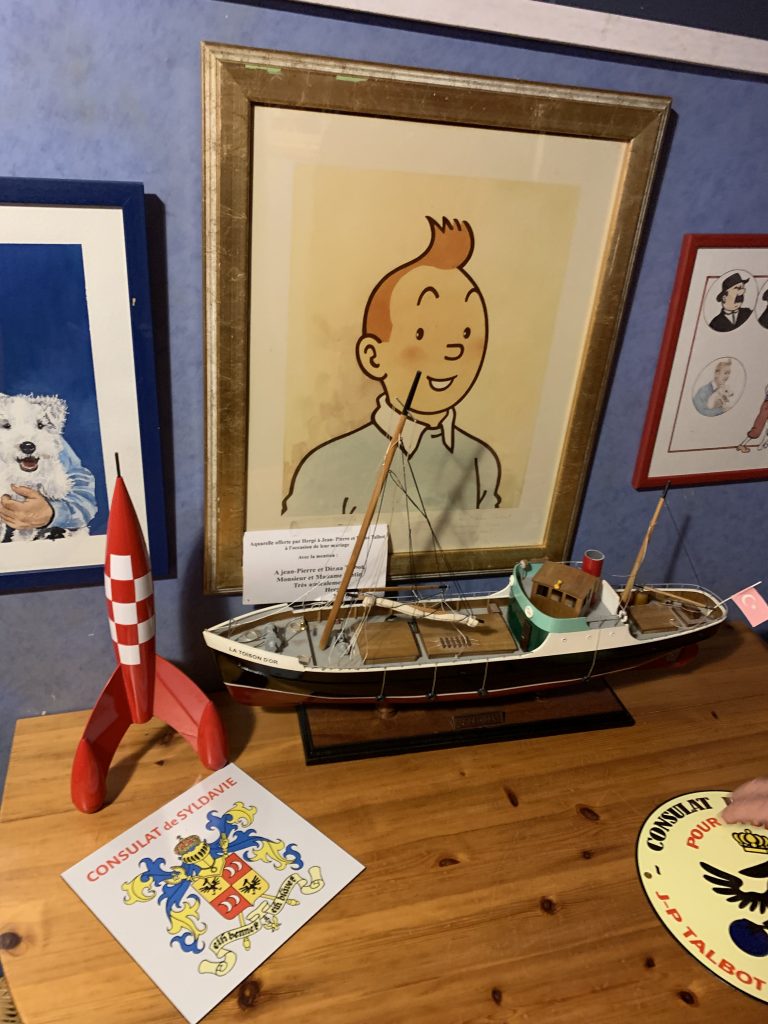
In a watercolor that Hergé gave me for my wedding, he wrote: “To Jean-Pierre and Diana Talbot. Mr. and Mrs. Tintin.” This is the second time he recognizes me as Tintin—and, once again, in a sublime way. He was already old, and I was already 40 or 45 years old, I’m not sure anymore. He must have been at least 65… or 75, sorry—I mix up the numbers a bit. He once told me, “Jean-Pierre, it’s wonderful: you’ve never demystified my character.”
That conversation was originally published on BulletProof Action, in January 2026